
Imagine AI Review – Introduction
The digital-product market is full of opportunity, but creating professional assets consistently remains a major obstacle for publishers, Etsy sellers, educators, freelancers, and online entrepreneurs. Producing a single coloring book, printable bundle, worksheet collection, journal cover, sticker pack, or seamless-pattern set can involve hours of prompt writing, repeated generations, manual editing, file formatting, and quality control.
Imagine AI is designed to simplify that process.
Rather than asking users to master complicated image-generation prompts, connect external API keys, or move repeatedly between unrelated tools, Imagine AI provides a guided creative environment built around specialized digital-product workflows. Users choose what they want to create, select preferences from structured controls, and let the platform construct the underlying generation instructions.
The product is scheduled to launch on August 3, 2026, at 9:00 a.m. EDT, with a publicly listed front-end launch price of $27. The launch listing identifies Anton Fui as the vendor, WarriorPlus as the affiliate network, and software as the product category.
This Imagine AI review examines the complete front-end offer, its core features, expected workflow, credit system, optional upgrades, commercial applications, advantages, limitations, vendor bonuses, and the five exclusive implementation bonuses available when purchasing through this review.
The most important point is that Imagine AI should not be viewed as a push-button income system. It does not research every market, create a complete brand, publish listings, handle customer support, or guarantee marketplace sales. Its value is more practical: it is intended to reduce the friction between having a digital-product idea and producing the visual assets required to turn that idea into something publishable.
For creators who understand that distinction, the offer becomes considerably more interesting.
Imagine AI Review – Overview
Imagine AI is a cloud-based creative platform developed for people who want to build commercial digital assets without becoming advanced prompt engineers.
The front-end package is promoted as including 15 specialized creation modes, 3,000 credits for the first 30 days, commercial-use rights, guided controls, and six vendor bonuses. Launch information currently lists the initial front-end price as a one-time $27 payment, although pricing, credits, availability, and checkout terms may change during or after the promotional period.
| Product Detail | Information |
|---|---|
| Product Name | Imagine AI |
| Product Type | Cloud-based AI creative software |
| Vendor Team | The Bros Studio |
| Named Vendor | Anton Fui |
| Launch Date | August 3, 2026 |
| Launch Time | 9:00 a.m. EDT |
| Front-End Launch Price | $27 one-time |
| Core Creation Modes | 15 guided modes |
| Initial Credits | 3,000 credits for the first 30 days |
| Prompt Writing Required | Not required for the guided workflow |
| External API Key Required | No |
| Commercial Usage | Included according to the launch materials |
| Vendor Bonuses | Six bonuses with a stated combined value of $204 |
| Exclusive Review Bonuses | Five additional resources with a stated combined value of $435 |
| Primary Users | KDP publishers, Etsy sellers, TPT creators, digital-product sellers, designers, and freelancers |
| Optional Upgrades | Imagine Control Suite and Imagine Growth Suite |
| Checkout Platform | WarriorPlus |
| Overall Assessment | Strong fit for guided digital-asset production |
The offer’s main distinction is its product-first interface.
Most general AI art platforms begin with an empty prompt box. That approach provides flexibility, but it also places the entire burden of art direction on the user. You must know how to describe the subject, composition, line weight, lighting, style, background, output format, negative elements, and intended use.
Imagine AI attempts to reverse that process.
Instead of starting with technical instructions, users start with the commercial asset they want to make. They might choose a coloring-page workflow, book-cover workflow, card workflow, digital-paper workflow, seamless-pattern workflow, or another specialized mode. The software then presents relevant options and constructs the generation prompt behind the interface.
That design makes Imagine AI especially relevant to beginners, non-designers, and busy publishers who care more about producing usable product assets than learning the vocabulary of generative-image prompting.
What Is Imagine AI?
Imagine AI is best described as a guided AI asset-production system for digital-product creators.
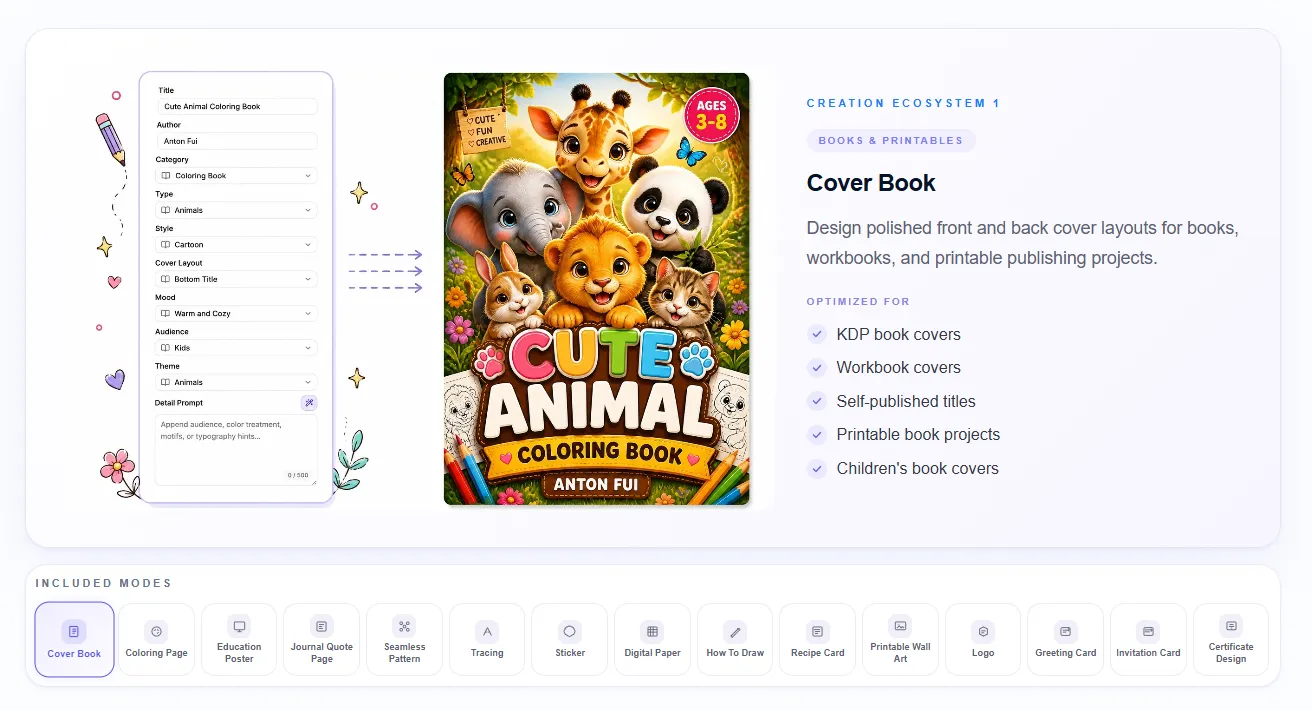
It is not merely an open-ended text-to-image generator. Its defining feature is a collection of specialized creation modes built around common commercial use cases. Launch materials describe modes for assets such as book covers, coloring pages, quote pages, greeting cards, invitations, digital papers, seamless patterns, business documents, stickers, wall art, logos, and related publishing graphics.
The platform is designed to help users create visual materials for marketplaces and business models including:
- Amazon KDP books
- Etsy digital downloads
- Teachers Pay Teachers resources
- Gumroad product bundles
- Printable marketplaces
- Creative asset stores
- Client design services
- Print-on-demand products
- Personal ecommerce websites
- Social-media content packages
The central promise is not that every output will be perfect immediately. No responsible review should suggest that an AI generation tool eliminates the need for inspection, editing, formatting, market validation, or compliance checks.
The stronger and more realistic promise is that Imagine AI can reduce four common production barriers.
1. Prompt-Writing Friction
Prompt writing is often presented as a simple task, but consistent commercial production requires more than typing a few descriptive words.
A coloring-page prompt, for example, may need instructions concerning line thickness, closed shapes, background complexity, shading, age suitability, composition, subject positioning, and printable clarity. A seamless-pattern prompt requires a different set of considerations. A book cover requires another.
Imagine AI handles much of that structure behind the scenes.
Users select the relevant options instead of writing every technical direction manually. The platform’s value therefore comes partly from encoding reusable generation logic into accessible controls.
2. Workflow Fragmentation
A typical digital-asset workflow can require several applications:
- One tool for idea generation.
- Another tool for prompt drafting.
- An image generator.
- A design editor.
- A background-removal tool.
- A file converter.
- A publishing template.
- A marketplace listing system.
Imagine AI does not necessarily replace every stage, but it is intended to consolidate the initial asset-generation process. That can reduce context switching and make it easier to develop cohesive product collections.
3. Technical Setup
Some platforms require users to connect APIs, purchase third-party credits, understand model settings, or configure integrations.
Imagine AI is promoted as working without an external API key. Users purchase access, enter the cloud dashboard, and work with the credits associated with their account.
This matters because unexpected API costs and complicated configurations can discourage beginners before they finish their first product.
4. Product Direction
General AI tools can generate almost anything, but that freedom can create decision paralysis.
Imagine AI narrows the field by organizing creation around recognizable product categories. That limitation can be useful. A creator does not need infinite possibilities; a creator needs a repeatable path to a finished collection.
Imagine AI Review – Features and Benefits
15 Specialized Creation Modes
The front-end offer provides access to 15 purpose-built creation modes.
Documented mode examples include:
- Cover Book
- Coloring Page
- Journal Quote Page
- Greeting Card
- Invitation Card
- Digital Paper
- Seamless Pattern
- Business Documents
Other launch descriptions reference workflows involving stickers, wall art, logos, stationery, printable graphics, and related commercial assets.
The benefit of these modes is specialization.
A user creating a coloring book should not have to use the same generic settings as someone creating a wedding invitation. Different products require different visual structures, and Imagine AI attempts to present controls that match the selected product type.
For publishers working across several niches, having multiple modes inside one dashboard can also support catalog expansion. A user might begin with coloring pages, move into matching covers, create a related digital-paper bundle, and then produce promotional graphics around the same theme.
Dropdown-Based Creative Controls
Instead of depending entirely on a blank prompt field, Imagine AI uses structured preferences.
Depending on the selected mode, users may be able to choose variables such as:
- Subject
- Theme
- Design style
- Visual complexity
- Composition
- Orientation
- Line-art style
- Background treatment
- Audience
- Mood
- Layout
- Product format
This approach provides two major advantages.
First, it reduces the intimidation associated with prompt engineering. Second, it can improve repeatability because creators can use similar combinations across a coordinated product line.
For example, an Etsy seller could create a collection around a single seasonal theme and maintain related colors, subjects, and styles across digital paper, greeting cards, printable wall art, and stickers.
Behind-the-Scenes Prompt Construction
Imagine AI’s guided controls serve as the visible layer of a more detailed prompt-building process.
The software is promoted as combining user selections with pre-engineered instructions relating to style, contrast, composition, and unwanted elements.
This is one of the most valuable aspects of the product for beginners.
New users often know what they want but do not know how to communicate it to an AI model. They might understand that they need a simple children’s coloring page, yet struggle to specify bold outlines, open spaces, limited detail, centered composition, and a clean white background.
Imagine AI turns familiar preferences into model instructions.
3,000 Initial Credits
The front-end offer includes 3,000 credits during the first 30 days, according to current launch materials. The number of outputs those credits produce can depend on the selected mode, resolution, generation settings, and credit cost per action.
The practical value of the credit allocation depends on how deliberately it is used.
Three thousand credits can be valuable when directed toward validated product concepts. The same credits can disappear quickly when spent on random experimentation without a niche, target buyer, product format, or quality standard.
That is why the Credit-Smart Product Validation System, included in our exclusive bonus package, is important. It helps buyers evaluate ideas before committing credits to them.
Commercial-Use Positioning
The launch materials state that generated assets include commercial usage rights, allowing creators to use qualifying outputs in products sold through platforms such as Amazon KDP, Etsy, Teachers Pay Teachers, Gumroad, ecommerce stores, and client projects.
However, commercial rights do not remove every responsibility from the creator.
Users should still avoid:
- Trademarked characters
- Protected logos
- Celebrity likenesses used without permission
- Copyrighted brand elements
- Marketplace-prohibited content
- Misleading commercial claims
- Assets that duplicate existing protected work
- Designs that violate platform-specific AI policies
Commercial permission from a software vendor is only one part of safe commercial use. Every seller remains responsible for the originality, legality, quality, and marketplace compliance of the final product.
No External API Key
Imagine AI is presented as an out-of-the-box web application that does not require the buyer to connect an OpenAI, Midjourney, or other external generation API.
That gives beginners a more predictable starting point.
The user does not need to create a developer account, generate secret keys, monitor separate usage charges, or troubleshoot an integration before producing an asset.
Cloud-Based Access
Because Imagine AI runs through a browser, users do not need to install large desktop applications.
Cloud access can be beneficial for:
- Creators working from multiple devices
- Freelancers managing client assets
- Publishers who travel
- Teams using shared production procedures
- Beginners with limited computer storage
- Users who prefer centralized asset generation
As with any cloud product, access remains dependent on the platform’s availability, account status, internet connection, and ongoing vendor support.
Faster Product Prototyping
Imagine AI can be particularly useful during the prototype stage.
Suppose a seller is considering three possible coloring-book niches. Instead of paying a designer to create a complete book for each idea, the seller could use Imagine AI to develop a small sample set, create cover concepts, compare visual directions, and validate the strongest concept before expanding production.
This reduces the cost of exploring ideas.
It can also help creators develop product variations more quickly. Once a promising theme is identified, the same core concept can be adapted into:
- A coloring book
- A printable activity pack
- A digital-paper collection
- A sticker bundle
- A journal
- A greeting-card set
- A classroom resource
- A wall-art collection
Consistent Production Framework
Consistency is one of the most difficult parts of AI-assisted product creation.
Even when individual images look attractive, a commercial bundle can feel unprofessional when the visual style changes dramatically from one file to the next.
Imagine AI’s presets and mode-specific controls may help users maintain a more consistent direction by repeating similar selections. Human review is still required, but the structured process gives creators a clearer baseline than random prompting.
Support for Multiple Marketplaces
Imagine AI is not restricted to one publishing platform.
Its broader appeal comes from supporting workflows relevant to KDP, Etsy, Teachers Pay Teachers, Gumroad, printable stores, freelance services, and direct ecommerce.
That flexibility may help buyers diversify their product catalog rather than depending on a single marketplace.
A KDP publisher, for instance, could repurpose an original visual theme into downloadable products for Etsy. An educator could turn classroom illustrations into worksheets, flashcards, posters, and activity packs. A designer could use generated concepts as starting points for client deliverables.
The final file should always be adapted to the destination platform rather than uploaded everywhere without modification.
How Does It Work?
Imagine AI follows a simple three-stage workflow.
Step 1: Choose a Creation Mode
The first step is selecting the type of asset you want to produce.
This decision should be connected to a commercial objective. Do not begin with “I want to generate something.” Begin with a more useful statement:
“We want to create a 30-page bold-line animal coloring book for parents purchasing printable activities for children aged four to seven.”
That objective immediately clarifies the mode, audience, style, complexity, output quantity, and packaging requirements.
Step 2: Select the Relevant Options
After choosing a mode, users configure the asset through the available dropdowns and controls.
A coloring-page workflow might involve selecting an audience, theme, line complexity, composition, or style. A greeting-card workflow may emphasize occasion, visual tone, subject, and layout. A pattern workflow may focus on motif, aesthetic, density, and color direction.
The software converts these choices into the more technical generation instructions required by the AI system.
Step 3: Generate the Asset
Once the settings are selected, the user starts the generation.
The action consumes account credits according to the system’s current credit rules. The resulting asset appears in the dashboard or gallery for review and download.
Step 4: Inspect the Output
This is the step many promotional reviews overlook.
Every output should be inspected carefully for:
- Distorted anatomy
- Unwanted objects
- Broken lines
- Inconsistent details
- Unreadable text
- Strange symbols
- Repeated elements
- Cropped subjects
- Uneven borders
- Poor composition
- Visible artifacts
- Intellectual-property concerns
AI generation speeds up production, but it does not eliminate quality control.
Step 5: Edit and Format
A raw generated image is not always a finished commercial product.
Depending on the marketplace, users may still need to:
- Resize the asset
- Increase resolution
- Clean small defects
- Remove a background
- Add typography
- Apply margins or bleed
- Create page layouts
- Export multiple file formats
- Build mockups
- Write instructions
- Include a license
- Package files into folders or ZIP archives
Imagine AI is most valuable when placed inside a complete production workflow rather than treated as the entire business.
Step 6: Package the Product
Packaging affects perceived value.
A random folder containing image files does not feel as professional as a clearly named bundle with organized subfolders, usage instructions, preview sheets, licensing information, and properly exported formats.
Our Digital Product Packaging & Bundle Blueprint was created to help buyers complete this stage.
Step 7: Publish and Promote
The final stage is listing the product on the chosen marketplace.
This involves keyword research, product positioning, title creation, image preparation, pricing, description writing, FAQs, promotional content, and customer support.
Imagine AI removes part of the creation bottleneck, but sellers must still complete the commercial work that turns an asset into an offer.
Imagine AI Review – My Experience Using It?
For transparency, our assessment should not be confused with a long-term revenue case study.
We have evaluated Imagine AI through the available launch documentation, disclosed workflow, feature information, pricing structure, creation-mode descriptions, credit model, and its practical fit within a real digital-product production process. We are not presenting invented marketplace revenue, fabricated customer results, or an unverified claim that every generated asset is perfect.
From a workflow perspective, the strongest aspect of Imagine AI is its guided product orientation.
The software does not force a beginner to translate a commercial idea into advanced generative-art terminology. It gives the user a starting framework based on the type of product being created.
That matters more than it may initially appear.
When users open a general AI generator, they often spend a significant amount of time experimenting without a clear quality threshold. They generate attractive images but do not know whether those images belong in a profitable bundle, meet a marketplace requirement, or support a consistent product line.
Imagine AI’s mode-based interface encourages a more focused process.
The likely experience is especially favorable for users who:
- Have little prompt-writing experience
- Want to create recognizable digital-product formats
- Prefer structured controls
- Need multiple visual concepts quickly
- Value speed over unlimited technical customization
- Want to explore several product categories
- Do not want to manage external APIs
The experience may be less compelling for advanced prompt engineers who already use custom models, complex negative prompts, reference-image workflows, control networks, or carefully tuned automation systems.
Those users may find guided dropdowns restrictive.
However, Imagine AI is not primarily positioned for technical AI artists. It is positioned for creators who want to move from concept to commercial asset with fewer decisions and less setup.
Our main recommendation is to use it with a controlled production plan:
- Choose one marketplace.
- Choose one customer segment.
- Validate one product concept.
- Create a small test collection.
- Inspect every output.
- Package the collection professionally.
- Publish it.
- Measure buyer response.
- Improve the next collection.
- Scale only after identifying a repeatable pattern.
This approach is more sustainable than generating hundreds of disconnected assets simply because credits are available.
Imagine AI Review – REVIEW – OTO DETAILS
Imagine AI uses a standard software funnel consisting of the front-end product and optional upgrades.
The upgrades are not required to use the core 15-mode system. They are intended for users who want greater control, more production options, additional prompt resources, or higher-volume functionality.
Pricing and upgrade details can change, so buyers should review the live checkout page before completing each transaction.
Front End: Imagine AI – $27
The core offer is currently listed at $27 as a one-time launch payment.
It includes:
- The Imagine AI cloud platform
- 15 specialized creation modes
- Guided dropdown controls
- Behind-the-scenes prompt construction
- 3,000 credits for the first 30 days
- Commercial-use rights according to the offer materials
- Six vendor bonuses
- No external API-key requirement
Launch information also describes an optional credit subscription after the introductory period: $15 per month for 7,000 new credits every 30 days, cancelable separately from the original software purchase. This means the front-end software is sold as a one-time purchase, while ongoing credit replenishment may involve an optional recurring plan.
This distinction should be understood before purchasing.
The software license and the ongoing generation credits are related but not identical. Heavy users may need additional credits after the first-month allocation is exhausted or expires.
OTO 1: Imagine Control Suite – $47
The first optional upgrade is listed as Imagine Control Suite, with a launch price of $47.
It reportedly adds six control modules designed to give users more flexibility over the generation process. The disclosed upgrade functions include capabilities related to:
- Writing or entering manual prompts
- Saving successful prompts
- Improving output quality
- Producing multiple variations
- Selecting aspect ratios
- Organizing a growing asset library
The Control Suite appears most relevant to users who like the simplicity of the core platform but eventually want more influence over how assets are generated and managed.
Who Should Consider OTO 1?
OTO 1 may be worthwhile for:
- Experienced creators who want manual prompt access
- Sellers creating multiple product variations
- Publishers who need several aspect ratios
- Users building a large asset library
- Freelancers managing different client projects
- Buyers who want to preserve successful prompt configurations
Who Can Skip OTO 1?
You can probably skip it when:
- You only need the 15 guided modes
- You prefer simple dropdown controls
- You are testing the business model
- You do not need advanced prompt management
- You want to minimize initial spending
The front end is intended to function without this upgrade.
OTO 2: Imagine Growth Suite – $97
The second optional upgrade is listed at $97.
Launch descriptions state that it adds:
- Five additional product-focused modes
- Four extra tools
- A library of 50,000 prompts
- Seasonal and color-theme inspiration
- Additional opportunities for catalog expansion
This upgrade is positioned for users who want to broaden their range of products and access a larger idea library.
Who Should Consider OTO 2?
The Growth Suite may be useful for:
- High-volume digital-product sellers
- Agencies
- Freelancers serving multiple niches
- Publishers building large catalogs
- Users who need ongoing seasonal ideas
- Creators who regularly experience idea fatigue
- Sellers who have already validated a product workflow
Who Can Skip OTO 2?
It may be unnecessary when:
- You are completely new
- You have not published your first product
- You have not used the original 15 modes
- You already have a strong idea pipeline
- You are buying only for one product category
- You want to validate the front end before expanding
A larger prompt library does not automatically produce a stronger business. Validation, execution, packaging, and positioning remain essential.
Recommended Funnel Decision
For most beginners, the sensible approach is:
- Start with the $27 front end
- Use the initial credits strategically
- Complete at least one polished product
- Evaluate the output quality and workflow
- Upgrade only when a specific limitation appears
Advanced users who already know they need manual prompts, prompt saving, variant generation, aspect-ratio control, or larger product libraries may find the upgrades more immediately relevant.
Pros and Cons
Imagine AI Pros
1. No Advanced Prompt Engineering Required
The guided workflow makes the platform accessible to people who understand digital products but do not understand sophisticated AI prompting.
2. Built Around Commercial Asset Types
Imagine AI focuses on recognizable products rather than generic art generation.
3. Fifteen Creation Modes in the Front End
The range of modes gives users multiple ways to build and expand a catalog.
4. No External API-Key Setup
Users can begin without connecting separate developer accounts or configuring third-party usage billing.
5. Initial 3,000-Credit Allocation
The first-month credits provide room to test several product concepts when used carefully.
6. Commercial-Use Positioning
The offer is intended for creators who want to monetize qualifying outputs, subject to applicable terms and marketplace rules.
7. One-Time Front-End Launch Price
The current $27 entry price is relatively accessible for a specialized creative platform.
8. Useful for Product Prototyping
Sellers can test visual concepts before investing in larger collections.
9. Supports Multiple Business Models
The assets may be adapted for KDP, Etsy, TPT, Gumroad, ecommerce, client work, and printable stores.
10. Optional Advanced Upgrades
Users can begin with the guided system and add greater control only when needed.
Imagine AI Cons
1. Credits Are Not Unlimited
The core purchase includes an initial credit allocation. Ongoing production may require top-ups or an optional recurring credit plan.
2. AI Outputs Still Require Review
Users must check anatomy, text, composition, originality, technical quality, and marketplace suitability.
3. It Does Not Publish Products for You
Listing creation, customer research, packaging, pricing, SEO, and promotion remain the buyer’s responsibility.
4. Guided Controls May Limit Advanced Users
Experienced prompt engineers may prefer complete manual control.
5. Product Quality Depends on User Direction
Weak niche selection and unclear product strategy can still produce commercially weak results.
6. Marketplace Success Is Not Guaranteed
Owning software does not guarantee traffic, rankings, sales, royalties, or profits.
7. Long-Term Value Depends on Vendor Support
As a cloud platform, continued access depends on maintenance, infrastructure, and business continuity.
8. Launch Details Can Change
Prices, credits, bonuses, upgrade names, and terms should be confirmed at checkout.
Who Should Use It?
Amazon KDP Publishers
Imagine AI is particularly relevant to publishers creating:
- Coloring books
- Journals
- Activity books
- Quote books
- Workbook graphics
- Book covers
- Decorative interiors
- Children’s publishing assets
The platform can accelerate visual concept development, but KDP users must still handle trim size, bleed, margins, page count, metadata, content review, and marketplace policies.
Etsy Digital-Product Sellers
Etsy creators may use the platform for:
- Printable wall art
- Sticker graphics
- Digital papers
- Seamless patterns
- Invitation designs
- Greeting-card graphics
- Planner assets
- Clipart bundles
- Journal covers
- Seasonal collections
The strongest Etsy strategy is not uploading isolated images. It is building cohesive bundles for clearly defined buyers.
Teachers Pay Teachers Creators
Educators can use generated assets as components of:
- Worksheets
- Flashcards
- Classroom posters
- Activity packs
- Educational games
- Bulletin-board materials
- Lesson resources
- Reward charts
All materials should be reviewed for educational accuracy, age suitability, readability, accessibility, and licensing compliance.
Gumroad Sellers
Gumroad creators may package themed asset collections, templates, printable kits, business resources, and design bundles.
Because Gumroad sellers control more of the sales-page experience, strong positioning and a well-designed bundle can significantly improve perceived value.
Freelancers and Designers
Freelancers may use Imagine AI to accelerate brainstorming, produce drafts, develop style directions, and prepare asset concepts for clients.
Client agreements should clearly explain the role of AI and the applicable usage rights.
Side-Hustle Beginners
Beginners who want to enter digital publishing without learning complicated prompt syntax may find the guided interface particularly helpful.
However, they should begin with one product and one marketplace rather than attempting to dominate every category immediately.
Who Should Not Use Imagine AI?
Imagine AI may not be a good fit for:
- Professional photographers needing advanced photo retouching
- Technical AI artists who want complete model control
- Users expecting guaranteed passive income
- Sellers unwilling to edit or inspect outputs
- People who need only one image
- Anyone planning to imitate protected brands or characters
- Buyers who assume software replaces market research
- Users who do not intend to publish or use the generated assets
Imagine AI Review – Price and Evaluation
At the listed $27 front-end launch price, Imagine AI offers an appealing entry point for creators who need repeated digital-asset production.
The value is strongest when the buyer has a clear use case.
A KDP publisher planning several coloring-book collections may recover more practical value than a casual user generating one illustration. An Etsy seller building themed bundles may benefit more than someone without a marketplace or product strategy.
Our evaluation is based on five areas.
| Evaluation Area | Score |
|---|---|
| Ease of Use | 9.4/10 |
| Beginner Accessibility | 9.5/10 |
| Commercial Usefulness | 9.2/10 |
| Creative Flexibility | 8.7/10 |
| Front-End Value | 9.4/10 |
| Overall Rating | 9.2/10 |
Ease of Use: 9.4/10
The guided mode system and structured controls reduce the technical barrier associated with general AI art tools.
Beginner Accessibility: 9.5/10
The lack of external API setup and prompt-writing requirements makes Imagine AI particularly approachable.
Commercial Usefulness: 9.2/10
The product categories align with common digital-marketplace opportunities. Final commercial success still depends on research, packaging, differentiation, and promotion.
Creative Flexibility: 8.7/10
Fifteen modes provide substantial variety, although advanced users may eventually want the additional controls available in OTO 1.
Front-End Value: 9.4/10
The $27 launch price, initial credits, 15 modes, commercial-use positioning, and vendor bonus package create a strong front-end offer.
Refund Considerations
Launch materials reference a 30-day refund policy, but the detailed conditions reportedly focus on genuine technical issues that support cannot resolve, such as access failures or critical system errors. Personal preference, accidental purchases, lack of use, or unmet income expectations may not qualify. Buyers should read the live refund terms carefully before ordering rather than assuming the policy is unconditional.
Imagine AI Vendor Bonuses
The vendor includes six bonuses with a stated combined value of $204.
Bonus 1: Digital Product Business Starter Roadmap – Stated Value $29
A beginner-oriented guide to selecting niches, identifying product opportunities, and establishing a digital-product workflow.
Bonus 2: Amazon KDP Beginner Publishing System – Stated Value $29
Training covering KDP-oriented formatting, publishing considerations, covers, interiors, margins, bleed, and listing preparation.
Bonus 3: Etsy Digital Product Launch Kit – Stated Value $29
A resource focused on packaging digital files, preparing mockups, creating Etsy listings, and organizing product delivery.
Bonus 4: Teachers Pay Teachers Resource Creator System – Stated Value $29
Guidance for packaging worksheets, educational graphics, classroom resources, and teacher-focused products.
Bonus 5: VIP Facebook Group Access – Stated Value $29
Community access intended to provide updates, discussions, product ideas, support, and networking.
Bonus 6: Digital Product Launch and Sales Operating System – Stated Value $59
A planning resource for organizing product creation, marketplace listings, launch activities, and performance tracking.
These bonuses add useful education, but the exclusive package below addresses an equally important issue: implementation.
Exclusive Imagine AI Bonuses Available Through This Review
When you purchase Imagine AI through the link in this review, you receive five additional bonuses with a stated combined value of $435.
These resources were designed to close the gap between owning the software and publishing a professional product.
The vendor bonuses provide general training. Our exclusive bonuses focus on product selection, execution, packaging, validation, conversion, and daily implementation.
Exclusive Bonus 1: The 30-Day Digital Product Profit Sprint – Value $97
Action Plan and Daily Checklist
This is a complete 30-day implementation plan that takes you from niche selection to publishing and promoting your first collection of digital products.
Every day contains:
- One focused action
- One specific deliverable
- One progress checkpoint
- A clear next step
The plan helps prevent a common problem: purchasing new software, exploring the dashboard for several hours, and then doing nothing commercially useful with it.
Why This Bonus Matters
Imagine AI can remove much of the asset-creation bottleneck.
It does not automatically decide what you should do first, what should happen next, how to organize a 30-day launch, or when a product is ready to publish.
The 30-Day Digital Product Profit Sprint supplies that missing structure.
Exclusive Bonus 2: 100 Proven Digital Product Ideas Vault – Value $67
Niche Idea Guide and Opportunity Matrix
This vault includes 100 curated digital-product concepts for:
- Etsy
- Amazon KDP
- Teachers Pay Teachers
- Gumroad
- Printable marketplaces
Each concept is mapped to:
- A target buyer
- A suggested product format
- A seasonal angle
- A bundle opportunity
- A recommended Imagine AI mode
Why This Bonus Matters
Many software buyers do not struggle with the mechanics of generating an image. They struggle with choosing what to create.
Without a product plan, credits are spent on random experiments that never become listings.
The 100 Proven Digital Product Ideas Vault gives buyers a structured starting point and helps direct the initial credit allocation toward practical product concepts.
Exclusive Bonus 3: Marketplace Listing Conversion Kit – Value $97
Templates, Worksheets, and Swipe Files
This resource includes:
- Product-title formulas
- Description templates
- Keyword worksheets
- Feature-to-benefit prompts
- Frequently asked question frameworks
- Listing-image checklists
- Marketplace-specific positioning guidance
Separate frameworks are provided for:
- Etsy
- Amazon KDP
- Teachers Pay Teachers
- Gumroad
Why This Bonus Matters
A strong asset does not automatically become a strong listing.
Customers must understand:
- What the product includes
- Who it is designed for
- How it solves a problem
- What file formats are provided
- How the product can be used
- Why it is different from alternatives
The Marketplace Listing Conversion Kit helps turn a finished asset into a clear commercial offer.
Exclusive Bonus 4: Digital Product Packaging and Bundle Blueprint – Value $77
Guide, Checklist, and Bundle Planner
This step-by-step system covers:
- File organization
- Folder structures
- Naming conventions
- Buyer instructions
- Preview images
- ZIP packaging
- Licensing documents
- Bonus additions
- Bundle planning
- Product-tier creation
- Bundle pricing
Why This Bonus Matters
Raw AI-generated assets can feel incomplete when sold individually without organization or supporting materials.
Professional packaging increases clarity, buyer confidence, usability, and perceived value.
This blueprint helps transform a group of generated files into a coherent product.
Exclusive Bonus 5: Credit-Smart Product Validation System – Value $97
Validation Workbook and Scoring Tool
This framework helps users evaluate ideas before spending Imagine AI credits.
Each concept can be scored on:
- Buyer intent
- Competition
- Differentiation
- Repeat-product potential
- Seasonal demand
- Production difficulty
- Bundle potential
- Marketplace fit
- Target-buyer clarity
- Expansion opportunities
Why This Bonus Matters
Three thousand introductory credits can support significant experimentation, but they can also be wasted rapidly.
The Credit-Smart Product Validation System encourages users to prioritize stronger opportunities before generating large quantities of assets.
Combined Bonus Value
| Bonus Package | Stated Value |
|---|---|
| Six Vendor Bonuses | $204 |
| Five Exclusive Review Bonuses | $435 |
| Total Stated Bonus Value | $639 |
The stated values are promotional valuations rather than guaranteed resale values or cash equivalents.
How to Claim the Exclusive Bonuses
- Purchase Imagine AI through the designated affiliate link in this review.
- Save your WarriorPlus purchase receipt.
- Submit the receipt using the bonus-claim instructions provided on this page.
- Allow the transaction to be verified.
- Receive access to the five exclusive bonus resources.
Important: Purchases made through another affiliate, another browser session, or a direct vendor link may not be tracked to this review and may not qualify for these exclusive bonuses.
Imagine AI Frequently Asked Questions
Does Imagine AI Require Prompt Writing?
The core guided workflow is designed to work without advanced manual prompt writing. Users select structured preferences, and the software constructs the prompt behind the interface.
Does Imagine AI Require an API Key?
The launch offer states that no external API key is required.
Can We Sell the Assets We Create?
The offer materials state that commercial usage is included. Users must still follow the product terms, marketplace rules, trademark law, copyright law, and applicable AI-content policies.
Is Imagine AI a Monthly Subscription?
The core front-end software is promoted as a $27 one-time launch purchase. However, the initial 3,000 credits apply to the first 30 days, and an optional recurring credit plan is described for users who need continued generation capacity.
Are the OTOs Required?
No. The core platform is intended to function without either upgrade.
Can Imagine AI Create a Complete KDP Book?
It can assist with visual assets such as covers, coloring pages, graphics, or related components. Users must still assemble, format, inspect, export, and publish the completed book.
Can Imagine AI Build an Etsy Store Automatically?
No. It can help create assets, but store setup, product research, listing optimization, customer service, pricing, and promotion remain the seller’s responsibility.
Will Imagine AI Guarantee Sales?
No software can guarantee sales. Results depend on product quality, niche selection, demand, competition, differentiation, pricing, presentation, promotion, and execution.
Is Imagine AI Suitable for Beginners?
Yes. Beginners are one of the platform’s clearest target groups because the core workflow reduces technical setup and prompt-writing requirements.
What Is the Best Way to Use the Initial Credits?
Begin with validated product ideas, generate small test batches, review quality, and expand only after identifying a strong concept. The Credit-Smart Product Validation System included in our exclusive bonus package was created specifically for this purpose.
Conclusion
Imagine AI offers a focused solution to one of the most persistent problems in digital-product publishing: turning an idea into usable visual assets without spending weeks learning prompt engineering or managing complicated software integrations.
Its strongest features are:
- 15 specialized creation modes
- Guided dropdown-based generation
- No external API-key requirement
- 3,000 initial credits
- Commercial-use positioning
- A low $27 front-end launch price
- Multiple digital-marketplace applications
- Optional advanced control and growth upgrades
- Six vendor bonuses
- Five exclusive implementation bonuses through this review
The platform is best suited to Amazon KDP publishers, Etsy sellers, Teachers Pay Teachers creators, Gumroad sellers, freelancers, printables entrepreneurs, and beginners who want a structured path into AI-assisted asset production.
It is not a substitute for product research, editing, quality control, packaging, SEO, publishing, or promotion. Buyers who expect fully automated income may be disappointed. Buyers who treat Imagine AI as a production tool inside a disciplined business workflow are more likely to recognize its practical value.
Our recommended approach is to begin with the front-end offer, use the initial credits to build one validated collection, package that collection professionally, publish it, and evaluate real buyer response before investing in optional upgrades.
At the current launch price, Imagine AI presents a compelling balance of accessibility, specialization, and commercial potential.
The exclusive bonus package makes the offer more complete by addressing what happens after the software generates an asset. It supplies the implementation plan, idea vault, listing frameworks, packaging system, and validation workbook needed to move from experimentation toward publication.
For creators who have been delayed by prompt complexity, disconnected tools, unclear product ideas, or an inconsistent production process, Imagine AI deserves serious consideration.
Imagine AI Review