
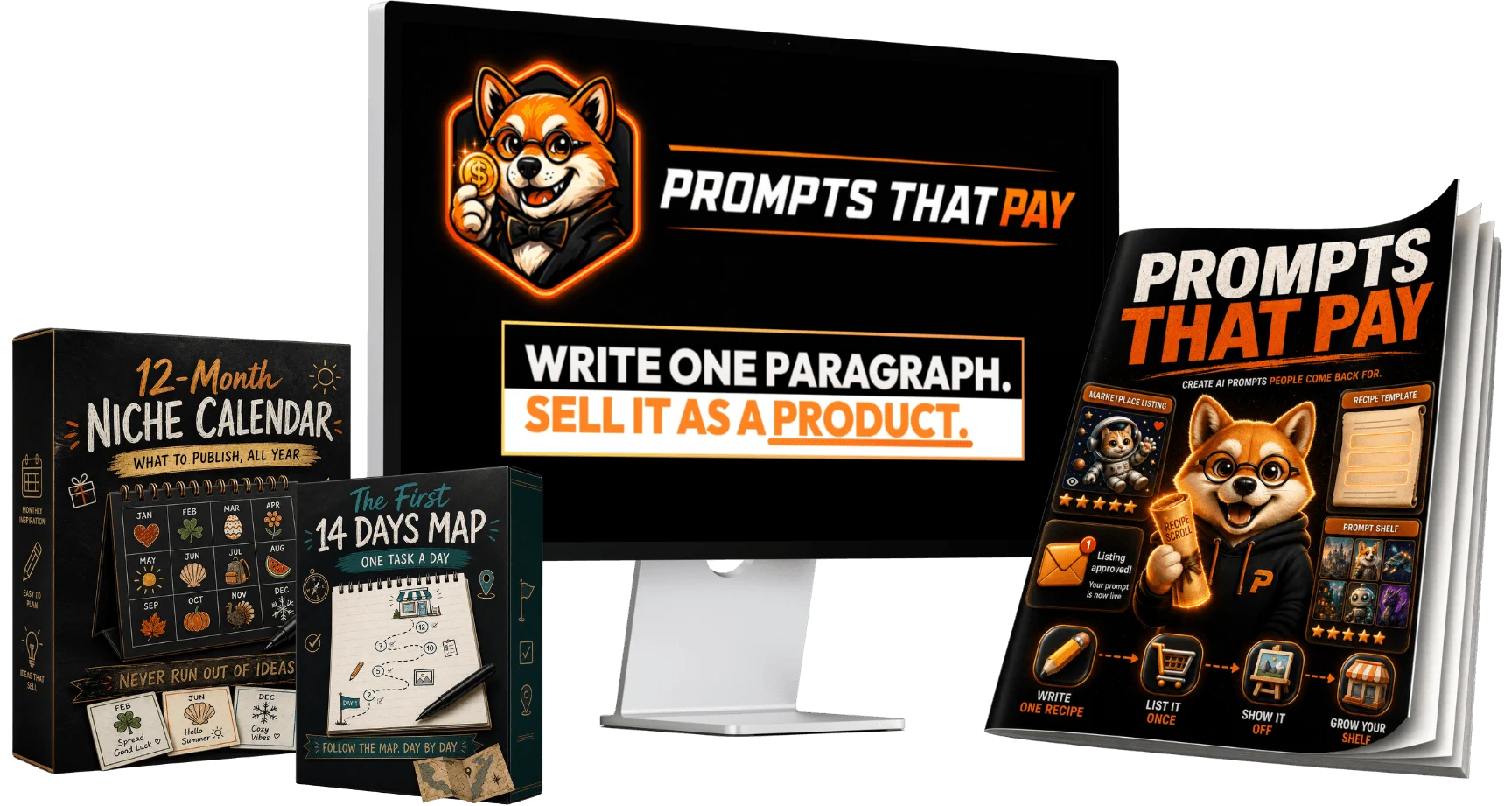
Prompts That Pay Review — Prompts That Pay is a practical online playbook created to show beginners how to develop reusable ChatGPT image prompts, package them as digital products, and publish them on PromptBase without building a store, growing an audience, managing inventory, or learning professional design software.
Rather than teaching another complicated AI agency model, Prompts That Pay focuses on one straightforward opportunity: selling the instructions behind AI-generated images.
A buyer may not want to spend hours experimenting with prompt wording, visual styles, composition instructions, lighting details, aspect ratios, or negative constraints. That buyer may happily pay a few dollars for a tested prompt recipe that consistently produces the desired type of image.
Prompts That Pay teaches us how to create those reusable recipes and position them as products.
The front-end offer currently costs $17, includes an eleven-step playbook, provides two vendor bonuses, and comes with a 30-day money-back guarantee. The product is delivered as a private online guide rather than downloadable software or a traditional static PDF.
In this comprehensive Prompts That Pay review, we will examine the training, workflow, features, front-end offer, upgrades, strengths, limitations, target audience, pricing, and exclusive affiliate bonuses so that readers can decide whether this product matches their goals.
Affiliate disclosure: This review contains an affiliate link. We may receive a commission when a purchase is made through our link, at no additional cost to the buyer. Prompts That Pay is an educational product and does not guarantee income, sales, marketplace approval, or financial results.
Prompts That Pay Review – Introduction
AI image generation has made it possible for almost anyone to create posters, coloring pages, stickers, illustrations, printable graphics, educational visuals, and marketing assets by entering written instructions into an AI platform.
However, having access to an AI tool does not automatically mean a user knows how to produce a polished result.
The quality of an AI-generated image often depends on the quality of the instructions. A vague sentence may generate inconsistent, generic, or unusable output. A carefully structured prompt can control the subject, composition, perspective, style, line quality, colors, background, mood, detail level, and intended use.
This difference creates a market for pretested prompts.
Customers who purchase prompts are not merely buying words. They are purchasing convenience, consistency, and a faster route to a specific outcome. Instead of spending an evening testing dozens of prompt variations, the customer can buy a prepared template, replace a variable, and generate the required image.
Prompts That Pay treats these reusable templates as small digital products.
The model is appealing because a prompt does not need to be manufactured, packed, shipped, or recreated for every customer. Once a prompt has been written, tested, demonstrated, and listed, the same product can potentially be delivered repeatedly.
The product’s official sales page presents a simple three-part process:
- Write a reusable prompt recipe.
- Create example images that demonstrate its output.
- Package and publish the listing correctly.
The training then expands these steps into an organized eleven-step process covering niche selection, prompt creation, listing preparation, marketplace review requirements, shop configuration, pricing considerations, and catalog growth.
This is important because creating a prompt is only part of the work.
A seller must also choose an appropriate market, make the prompt adaptable, test it across different variables, produce convincing examples, write a clear product description, configure the marketplace account, and avoid mistakes that could cause the listing to be rejected.
Prompts That Pay is designed to remove much of that early uncertainty.
It is not positioned as an automated income system, a push-button business, or software that operates without user involvement. The creator explicitly describes prompt creation as a craft that still requires judgment, testing, writing, and consistent implementation.
That honest positioning makes the offer more useful for buyers who want a realistic process rather than exaggerated promises.
Prompts That Pay Review – Overview
| Product Detail | Information |
|---|---|
| Product name | Prompts That Pay |
| Creator | Kevin Huynh |
| Product type | Online training guide and implementation playbook |
| Primary topic | Creating and selling reusable AI image prompts |
| Primary marketplace | PromptBase |
| Front-end price | $17 at the time of this review |
| Regular displayed price | $39 |
| Delivery format | Private online guide |
| Core training structure | Four parts and eleven steps |
| Required experience | Beginner-friendly |
| Required tools | ChatGPT account and PromptBase account |
| Vendor bonuses | 12-Month Niche Calendar and First 14 Days Map |
| Refund period | 30 days |
| Upsells available | Yes |
| Complete funnel value | Up to $276 |
| Exclusive affiliate bonus | Five bonuses with a stated combined value of $415 |
| Income guarantee | None |
The creator of Prompts That Pay is Kevin Huynh, who states that he has been using PromptBase for approximately two years and selling his own prompt listings for several months. The promotional material includes examples from his shop, listing screenshots, marketplace notifications, payment emails, and a real listing rejection that was analyzed and corrected.
The core product is not an app, plugin, automation platform, or subscription.
It is a living online guide that can be read from a computer, tablet, or mobile device. Because it is hosted online, updates can be added to the buyer’s existing access without requiring a new download. The two vendor bonuses are provided as downloadable resources.
The guide focuses on PromptBase, a marketplace dedicated to buying and selling prompts for AI tools. The vendor’s sales material references marketplace figures of more than 310,000 listings, over 500,000 users, and more than 42,000 reviews. These figures indicate marketplace scale, but they should not be interpreted as a guarantee that a new listing will receive views or sales.
At its core, Prompts That Pay teaches a marketplace-first digital product strategy.
Instead of beginning with a personal website and then searching for traffic, the user publishes products on a platform where potential buyers already browse prompt categories. The seller still needs to create an appealing product, but marketplace discovery may reduce the need to build an audience from zero.
What Is Prompts That Pay?
Prompts That Pay is a step-by-step educational program that teaches users how to create fill-in-the-blank ChatGPT image prompts and sell them as reusable digital products.
A prompt recipe is more structured than a simple one-line instruction.
For example, a weak prompt might ask ChatGPT to create an educational poster about history. A stronger prompt could specify the illustration style, information hierarchy, typography, icon placement, visual texture, background, composition, print format, and a customizable field such as [HISTORY TOPIC].
The buyer can replace that field with Ancient Egypt, the Roman Empire, the French Revolution, or another topic while preserving the overall visual formula.
The prompt therefore behaves like a reusable miniature production system.
Prompts That Pay teaches us to design that system, verify that it works, and present it in a way that makes its value understandable to buyers.
The official product page organizes the process into four parts and eleven steps. Among the specifically described lessons are:
- Understanding the difference between selling finished images and selling reusable prompt recipes.
- Navigating PromptBase and setting up an account.
- Identifying listing issues that may trigger marketplace rejection.
- Running a ten-minute niche validation check.
- Using a three-prompt “Assembly Line” to generate, filter, and develop product ideas.
- Configuring shop and payout settings.
- Studying live product case studies.
- Understanding PromptBase’s subscriber-related settings.
- Preparing examples, listing copy, and submission materials.
The product’s main concept can be summarized as follows:
Do not compete only by selling AI-generated images. Sell tested instructions that help other people create the images they need.
That model can potentially serve customers such as teachers, self-publishers, printable sellers, marketers, social media managers, content creators, craft businesses, coloring-book publishers, and small online shop owners.
These customers may understand what they want visually but lack the time or skill to translate that goal into a reliable prompt.
A well-built prompt closes that gap.
Prompts That Pay Review – Features and Benefits
1. Beginner-Friendly Prompt Product Model
Prompts That Pay reduces the business model to a manageable product: one tested prompt recipe designed to create one recognizable category of image.
This is significantly easier to understand than a broad AI business course covering dozens of unrelated strategies.
Users are not required to launch a large membership site, create a complicated software product, manage client accounts, or provide a custom service after every transaction.
The beginner starts with one product and one listing.
This narrow focus is a major benefit because it reduces decision fatigue. Instead of asking how to build an entire AI business, the user can ask a more practical question:
What useful prompt recipe can we create, test, and publish first?
2. The Ten-Minute Niche Check
A common beginner mistake is developing a product before checking whether buyers appear interested in that type of result.
Prompts That Pay includes a niche-checking process intended to identify market opportunities without requiring paid research software. According to the product page, the process helps users examine demand, avoid crowded ideas, and reduce blind guessing.
This does not eliminate market risk.
No research method can guarantee sales. However, a structured niche check is more useful than creating products based entirely on personal preference.
A seller can compare categories, study existing listings, observe visual patterns, identify underdeveloped use cases, and select a product concept that has a clearer buyer.
3. The Three-Prompt Assembly Line
One of the strongest components is the Assembly Line, a sequence of three copy-and-paste prompts designed to move the user from an empty page to a developed template.
The first stage generates potential ideas.
The second stage filters out weaker concepts before the seller invests significant time.
The third stage develops the selected idea into a more complete four-part prompt template.
The training reportedly demonstrates the process with screenshots so buyers can see how each stage is applied.
The benefit is not that ChatGPT completes every part of the business automatically. Human review is still required.
The benefit is that users receive a repeatable product-development workflow. Once the process is understood, it can be reused when creating additional listings.
4. Listing Rejection Guidance
A prompt can be technically effective and still fail to become a live product if the marketplace listing does not meet submission requirements.
Prompts That Pay includes guidance on the triggers that can cause listings to be rejected. It also examines a real rejection from the creator’s shop and explains how it was corrected.
This feature may save beginners considerable frustration.
Without guidance, a new seller might not know whether the problem involves the prompt, examples, wording, formatting, category selection, or another listing element.
Understanding the approval process before submission can make the first attempt more organized.
It should still be noted that marketplace rules can change, and no training can guarantee approval. Sellers remain responsible for reviewing current platform requirements.
5. PromptBase Walkthrough
The guide includes screen-by-screen marketplace guidance rather than assuming users already know where to click.
This reportedly covers the process from account creation and shop setup through payout configuration and product publication.
This is especially valuable for buyers who are comfortable using ChatGPT but have never sold a digital product online.
Technical uncertainty frequently prevents beginners from acting. A screen-based walkthrough can turn an unfamiliar dashboard into a sequence of smaller tasks.
6. Product Showcase Guidance
Customers need to understand what a prompt can produce before purchasing it.
For that reason, example images are part of the product presentation.
Prompts That Pay teaches users to generate a showcase, select appropriate examples, and decide which output should lead the listing. The official workflow describes this as the second major stage between writing the recipe and publishing the product.
This matters because customers cannot evaluate a prompt merely by seeing its name.
They need evidence that the template works across different variables while maintaining a recognizable style.
A strong showcase can communicate versatility, consistency, and the intended use far more efficiently than a long explanation.
7. Real Case Studies
The program includes three examples drawn from the creator’s own shop.
The listed case-study topics include:
- A best-selling product examined decision by decision.
- A rejected listing that was corrected.
- A premium-price strategy applied to a live listing.
Case studies add practical context to abstract instructions.
They allow users to observe how product choice, prompt structure, presentation, pricing, and listing decisions connect to an actual marketplace listing.
However, case studies should be viewed as examples rather than promises. A strategy that worked for one seller may perform differently when applied to another niche, account, product, or period.
8. Catalog-Building Strategy
Prompts That Pay encourages users to think beyond one isolated listing.
A single product can test the workflow. A growing collection of prompts can create more entry points through which buyers may discover the seller’s work.
The product describes this as building a catalog one recipe at a time rather than treating one prompt as a lottery ticket.
This is a sensible approach.
Digital marketplace results are rarely determined by one attempt. Creating a catalog allows the seller to test different themes, styles, buyers, price points, and presentation strategies.
It also develops skill through repetition.
The first prompt may require extensive experimentation. Later products may become easier because the seller has already created a testing checklist, listing template, and quality-control process.
9. No Inventory or Shipping
A prompt is a digital product.
There is nothing physical to store, manufacture, package, or mail. The same prompt can be delivered to multiple buyers without producing a new unit for each purchase.
The sales page states that PromptBase processes payment and delivers the product to customers.
This does not mean the business requires no work.
Sellers must still research ideas, create prompts, test results, prepare examples, maintain quality, respond to marketplace changes, and potentially update products.
However, the absence of physical fulfillment makes the model operationally simple.
10. No Professional Design Background Required
Prompts That Pay is designed for users who can write instructions and evaluate visual output, not only for trained designers.
The sales page states that a free ChatGPT account and a free PromptBase account can provide the basic toolkit.
Users still need visual judgment.
A person must be able to recognize whether an output is clear, attractive, consistent, and relevant to the intended customer.
Nevertheless, the seller does not need to draw every illustration manually or master advanced graphic design software before creating a first listing.
11. Living Online Guide
Prompts That Pay is hosted as a private online guide.
The advantage of this delivery method is that updates can appear directly inside the product. Buyers do not need to download a new edition every time marketplace procedures or recommended methods are revised.
The trade-off is that users who strongly prefer offline PDFs may not consider the format ideal.
The vendor bonuses remain downloadable, but the main training itself is accessed online.
12. Vendor Bonus: 12-Month Niche Calendar
The first vendor bonus is the 12-Month Niche Calendar, presented with a stated value of $27.
It contains more than sixty niche ideas organized according to seasonal buyer interest and includes suggested publishing deadlines.
This bonus addresses a recurring product-development question:
What should we publish next?
Seasonal planning can help sellers work ahead instead of creating holiday-related products after buyer interest has already peaked.
13. Vendor Bonus: First 14 Days Map
The second vendor bonus is the First 14 Days Map, presented with a stated value of $17.
The resource provides a daily implementation plan intended to guide a new user from an empty account toward three submitted or live listings over two weeks. Each day includes a focused task, checkbox, and time budget.
This bonus is valuable for buyers who understand the training but struggle to organize implementation.
Rather than attempting everything at once, users can divide the launch process into smaller daily actions.
How Does Prompts That Pay Work?
Prompts That Pay follows a practical product-building sequence.
Step 1: Understand the Product Format
The user begins by learning why a reusable prompt can be treated as a product.
The objective is not to create a single finished image for one buyer. It is to build a flexible template that produces a consistent category of output after the buyer changes selected variables.
Step 2: Research the Marketplace
The seller examines PromptBase categories, listings, styles, price ranges, examples, and potential gaps.
The goal is to identify a useful outcome people may want to generate repeatedly.
This research could lead to prompt concepts involving educational posters, pet portraits, coloring pages, product mockups, clip art, journal graphics, social media images, decorative prints, or other visual applications.
Step 3: Validate the Niche
The ten-minute niche check helps the user evaluate whether the concept deserves further development.
At this stage, weak ideas can be rejected before they consume hours of testing and design work.
Step 4: Generate and Filter Ideas
The Assembly Line workflow uses ChatGPT to develop possible prompt products.
The first prompt scouts ideas, the second filters weaker options, and the third helps build the selected concept into a structured template.
Step 5: Write the Reusable Recipe
The user creates a detailed fill-in-the-blank prompt.
A quality recipe should be specific enough to produce a recognizable result while remaining adaptable enough for customers to personalize.
Variables may include the subject, profession, animal, event, historical period, color palette, theme, mood, text, or visual format.
Step 6: Test the Prompt Thoroughly
The prompt should be tested with multiple variables.
One successful image is insufficient because customers may use the prompt differently.
Testing reveals whether the wording produces consistent composition, appropriate detail, unwanted text, visual artifacts, or inconsistent styles.
Weak output should lead to prompt revision.
Step 7: Create Showcase Images
The seller generates representative examples that demonstrate the product’s capabilities.
These images should communicate both consistency and flexibility.
The examples should not all look identical, but they should clearly come from the same underlying prompt recipe.
Step 8: Prepare the Listing
The user writes the title, description, instructions, and supporting information.
The listing needs to tell buyers:
- What the prompt creates.
- Which tool it is designed for.
- Which variables can be customized.
- What the buyer receives.
- How the prompt should be used.
- What types of results are demonstrated.
Step 9: Run the Pre-Publish Checklist
Before submitting, the seller reviews the prompt, examples, title, description, formatting, category, and marketplace requirements.
The purpose is to identify preventable issues before the listing reaches review.
Step 10: Publish on PromptBase
The completed product is uploaded to the marketplace.
PromptBase then reviews the listing according to its current procedures.
Approval and sales are not guaranteed, but the user has followed a more structured process than someone publishing without guidance.
Step 11: Repeat and Build a Catalog
After the first listing, the user reviews what was learned and develops another product.
Over time, this creates a catalog instead of depending on one prompt.
The model therefore becomes:
Research → Create → Test → Showcase → Publish → Improve → Repeat
Prompts That Pay Review – My Experience Using It
For accuracy, we evaluated Prompts That Pay as a structured educational offer rather than pretending that purchasing a course automatically produces marketplace earnings.
Our strongest impression is that the program takes a potentially confusing idea and gives it a clear operational sequence.
The concept of selling prompts can initially sound too abstract. Many people understand how to sell an ebook, template, or printable because they can see the final file. A prompt is less tangible.
Prompts That Pay solves that communication problem by treating the prompt as a reusable recipe.
That framing immediately clarifies what customers are purchasing. They are buying a tested process for creating a specific type of image, not a random paragraph of generic AI instructions.
The Assembly Line also appears to be one of the most practical parts of the training.
Beginners frequently become stuck before creating anything because they cannot choose a niche. A structured series of prompts for generating, rejecting, and developing concepts can accelerate the first-product process.
We also appreciate the inclusion of rejection guidance.
Many online courses teach only the exciting creative step. They show users how to make a product but ignore submission standards, marketplace setup, payout configuration, and approval obstacles.
Prompts That Pay addresses those less glamorous details.
The case studies improve the offer further because they give buyers a point of reference. Examining a successful listing, a rejected listing, and a premium-positioned listing can help users understand that different decisions produce different marketplace outcomes.
The product is also appropriately honest about effort.
The vendor does not claim that buyers will become wealthy from one prompt. The official material repeatedly states that outcomes depend on product quality, effort, buyer demand, and market conditions.
That makes the training more credible.
Our main reservation is that the method remains dependent on a third-party marketplace.
PromptBase controls its review process, platform structure, fees, visibility mechanisms, and policies. A seller should therefore treat the platform as a useful distribution channel rather than an asset they personally control.
We would also avoid assuming that a few hours of work always produces a marketplace-ready product.
The vendor suggests that the initial workflow can be completed in a focused afternoon, but actual completion time will vary according to writing ability, niche complexity, testing requirements, AI output quality, and familiarity with digital marketplaces.
For a simple prompt, one afternoon may be realistic.
For a more demanding product that requires consistent typography, complex layouts, or several rounds of visual testing, additional time may be necessary.
Overall, our evaluation is positive because the product has a narrow objective, actionable structure, low entry price, practical bonuses, and realistic expectations.
It is best viewed as a starter playbook for learning a digital-product skill, not as an automatic income engine.
Prompts That Pay Review – OTO Details
Prompts That Pay includes a front-end product, an optional order bump, and four upgrades.
Buyers do not need every upgrade to use the main playbook. The front-end can be purchased independently.
Front End: Prompts That Pay – $17
The front-end includes:
- The complete eleven-step playbook.
- PromptBase walkthroughs.
- Rejection-trigger guidance.
- The ten-minute niche check.
- The three-prompt Assembly Line.
- Shop and payout configuration guidance.
- Three real product case studies.
- Listing and publication instructions.
- Future guide updates.
- The 12-Month Niche Calendar.
- The First 14 Days Map.
- A 30-day money-back guarantee.
For most beginners, the front-end contains enough material to understand and implement the core model.
Order Bump: Two More Categories – $11
The optional order bump expands the training beyond the main ChatGPT image-prompt approach.
It covers two additional categories:
- Midjourney prompts.
- Agent Skills.
The bump is intended for buyers who want to explore additional prompt-product formats rather than focusing exclusively on the front-end method.
OTO 1: Done-For-You Machines – $27
The first upgrade includes 10 ready-made machines associated with high-activity niches.
These systems are designed to help users create prompt products and related listing content with less manual setup.
This upgrade may suit beginners who want more guided production support after learning the underlying method.
However, users should still review, test, and customize generated material. Publishing identical output without quality control would reduce differentiation.
OTO 2: The Complete Studio – $57
The second upgrade adds 102 additional machines.
Combined with OTO 1, buyers receive a total of 112 niche-specific machines.
According to the JV page, these are intended to cover additional PromptBase niches rather than merely rewording one generic assistant.
This upgrade is most relevant to users planning to build a larger catalog across multiple categories.
A buyer creating only one or two prompts may not immediately need the entire collection.
OTO 3: Midjourney and Skill Machines – $67
The third upgrade provides 57 machines designed for the two categories introduced by the order bump:
- Midjourney prompt listings.
- Agent Skills.
When combined with the first two upgrades, the full collection reaches 169 machines.
This upgrade makes the most sense for buyers who purchased the order bump and want production assistance for those additional categories.
OTO 4: Reseller License – $97
The final upgrade provides reseller rights for the complete collection of 169 machines.
The JV material states that buyers receive rights to sell the machines as their own product, with a signed certificate.
This upgrade changes the use case significantly.
Instead of only using the machines internally to create prompt listings, the buyer may package and resell the machines under the included license terms.
Anyone considering this upgrade should carefully read the actual license before selling, modifying, bundling, or distributing the materials.
Complete Prompts That Pay Funnel
| Offer | Price |
|---|---|
| Prompts That Pay front end | $17 |
| Optional order bump | $11 |
| OTO 1: Done-For-You Machines | $27 |
| OTO 2: The Complete Studio | $57 |
| OTO 3: Midjourney and Skill Machines | $67 |
| OTO 4: Reseller License | $97 |
| Maximum funnel total | $276 |
The upgrades are optional.
Our recommendation is to start with the front-end, understand the business model, and determine whether prompt product creation suits your working style before purchasing every expansion.
Prompts That Pay Review – Pros and Cons
Pros
Affordable front-end access
At $17 at the time of this review, the initial cost is relatively low compared with many AI business courses.
Clear and narrow objective
The product teaches one specific model rather than overwhelming buyers with unrelated AI monetization ideas.
Suitable for beginners
The training begins with product selection and includes marketplace setup, prompt creation, testing, presentation, and publication.
No inventory or shipping
Prompt products can be delivered digitally without physical fulfillment.
No existing audience required to begin
The method uses a marketplace where customers already browse products, although visibility and sales remain uncertain.
Practical niche-validation process
The ten-minute niche check encourages users to evaluate ideas before investing significant time.
Repeatable Assembly Line workflow
The three-prompt system provides an organized way to generate, filter, and develop potential products.
Real listing examples
Case studies from a functioning shop make the instructions more concrete.
Rejection guidance
The training addresses listing problems that many beginner courses overlook.
Two useful vendor bonuses
The calendar supports product planning, while the 14-day map supports implementation.
Living online format
Future updates can be added without requiring buyers to download a new edition.
30-day refund period
The vendor offers a 30-day money-back guarantee under the terms stated on the sales page.
Cons
Dependent on a third-party marketplace
PromptBase can change its policies, review standards, fees, categories, or discovery system.
No guarantee of approval or sales
Following the training does not ensure that a listing will be accepted, discovered, or purchased.
Testing still requires effort
Users must evaluate outputs, revise prompts, select examples, and maintain product quality.
The main guide is not a downloadable PDF
Buyers who prefer fully offline training may dislike the online-only format.
Prompt markets can become competitive
Low barriers to entry mean sellers need strong ideas, reliable output, clear listings, and effective positioning.
Visual judgment remains important
Professional design credentials may not be required, but users must still recognize poor composition, inconsistent results, and unattractive examples.
Upsells increase the total cost
The complete funnel reaches $276, although the upgrades are optional.
Who Should Use Prompts That Pay?
Prompts That Pay is best suited to people who want to create small digital assets without managing physical products or providing custom client work.
Complete Beginners
The step-by-step structure can help users who have never sold a digital product before.
A beginner receives guidance on the concept, niche selection, prompt creation, testing, listing preparation, marketplace setup, and publication.
ChatGPT Users
Anyone already experimenting with ChatGPT image generation may be able to turn existing interest into a more structured product-development skill.
Instead of generating isolated images for personal use, the user learns to create reusable instructions for a specific customer.
Printable and Digital Product Sellers
Existing Etsy sellers, printable creators, journal publishers, coloring-book creators, and digital download businesses may use prompt products as an additional category or research tool.
They already understand the value of templates and repeatable assets.
Teachers and Educational Creators
Educational poster prompts, worksheet graphics, timeline illustrations, classroom decorations, and subject-specific visual resources can provide practical prompt-product ideas.
Self-Publishers
Authors and publishers may be interested in prompts for book illustrations, activity pages, coloring pages, covers, character concepts, decorative elements, or promotional graphics.
Freelancers Seeking Productized Assets
Freelancers typically exchange time for money.
A prompt listing offers a different model in which one tested asset can be delivered repeatedly, although demand and sales are never guaranteed.
Affiliate Marketers and Product Creators
The upsell machines and reseller license may interest marketers who want to package AI-related digital products.
They should review all license restrictions before resale.
Prompts That Pay Is Not Suitable For
The product is not suitable for people who:
- Expect guaranteed income.
- Refuse to test or improve AI output.
- Want software to operate the entire business automatically.
- Are unwilling to write product descriptions.
- Expect one listing to create immediate financial results.
- Do not want to rely on a third-party marketplace.
- Are unwilling to learn current platform rules.
- Prefer selling services rather than products.
The official sales page similarly states that Prompts That Pay is not designed for buyers seeking a push-button bot, refusing to write, or expecting rapid wealth without effort.
Prompts That Pay Review – Exclusive $415 Bonus Stack
Purchasing through the button in this Prompts That Pay review unlocks an additional five-part bonus stack with a stated combined value of $415.
These bonuses are supplied through our affiliate promotion.
They are not included on the vendor’s standard sales page and are available only to verified buyers who purchase through our designated affiliate link.
Only Through My Link — Not on the Vendor Page
My Exclusive $415 Bonus Stack
Buy Prompts That Pay through the button on this Prompts That Pay review page and receive these five custom bonuses.
The resources are designed to reduce common beginner mistakes, improve product quality, accelerate listing creation, and help buyers move from one product toward a growing catalog.
Exclusive Bonus #1: Prompt Product Profit Validator – $47 Value
Kill weak ideas before building them. Validate demand first and write second.
The Prompt Product Profit Validator is designed to help users evaluate an idea before investing time in prompt engineering, image testing, listing copy, and product presentation.
It provides a more deliberate way to compare product concepts according to buyer relevance, reusability, differentiation, visual potential, and marketplace fit.
This resource complements the niche-validation section of Prompts That Pay by helping users make a clearer go, revise, or reject decision.
Exclusive Bonus #2: High-Converting Prompt Listing Swipe Vault – $67 Value
Use structured listing copy so browsers understand the product and feel confident buying it.
A high-quality prompt may underperform when the listing fails to communicate its purpose.
The High-Converting Prompt Listing Swipe Vault provides fill-in-the-blank structures for writing titles, benefit-focused descriptions, usage explanations, feature sections, customer-fit statements, and calls to action.
The goal is not to copy generic hype.
The goal is to communicate what the prompt does, who it helps, how it can be customized, and why the buyer may prefer a tested recipe over hours of experimentation.
Exclusive Bonus #3: 50 Evergreen AI Prompt Product Ideas Vault – $77 Value
Start with fifty concepts that can be developed into reusable prompt recipes.
The blank page is one of the biggest obstacles for a new seller.
This vault provides fifty evergreen product concepts that can be researched, validated, customized, and transformed into listings.
The collection is intended to help buyers move beyond one idea and begin planning a broader product catalog.
Each concept should still be validated and differentiated before publication. The purpose of the vault is to accelerate ideation, not encourage identical listings.
Exclusive Bonus #4: AI Prompt Quality-Control Lab – $97 Value
Improve consistency, reduce weak output, and create more dependable prompt products.
A prompt product must work beyond one carefully selected example.
The AI Prompt Quality-Control Lab provides frameworks for testing prompts across different variables, identifying failure patterns, refining instructions, comparing output consistency, and establishing a quality threshold before publication.
Better testing can lead to stronger product demonstrations, clearer instructions, more realistic customer expectations, and fewer quality-related complaints.
Exclusive Bonus #5: 30-Day Prompt Catalog Growth Blueprint – $127 Value
Follow a day-by-day path from one listing toward a catalog of prompt products.
The first listing teaches the process.
A catalog creates multiple opportunities to practice, improve, and be discovered.
The 30-Day Prompt Catalog Growth Blueprint organizes product research, prompt creation, testing, listing preparation, publication, and performance review into a practical monthly schedule.
It is designed for users who do not want to stop after completing one product.
Total Exclusive Bonus Value: $415
| Exclusive Bonus | Stated Value |
|---|---|
| Prompt Product Profit Validator | $47 |
| High-Converting Prompt Listing Swipe Vault | $67 |
| 50 Evergreen AI Prompt Product Ideas Vault | $77 |
| AI Prompt Quality-Control Lab | $97 |
| 30-Day Prompt Catalog Growth Blueprint | $127 |
| Total stated bonus value | $415 |
These bonuses are free only when Prompts That Pay is purchased through our link.
Purchasing through another page may provide access to the vendor’s main product and vendor bonuses, but it will not qualify the buyer for this exclusive affiliate stack.
Claim Prompts That Pay and the Exclusive $415 Bonus Stack
After purchasing, retain the receipt or transaction details required by the bonus-delivery instructions on this website.
Prompts That Pay Review – Price and Evaluation
At the time of this review, the Prompts That Pay front-end is displayed at $17, reduced from a displayed regular price of $39. The vendor indicates that the promotional price may rise as sales are recorded, so buyers should verify the checkout total before completing a purchase.
For $17, buyers receive:
- The complete online playbook.
- Four-part, eleven-step training.
- PromptBase account and listing guidance.
- Prompt creation workflows.
- Niche research instructions.
- Rejection-trigger guidance.
- Shop setup information.
- The three-prompt Assembly Line.
- Three case studies.
- The 12-Month Niche Calendar.
- The First 14 Days Map.
- Future guide updates.
- A 30-day refund period.
From a value perspective, the front-end is competitively priced.
Even one useful lesson on niche selection, prompt testing, listing presentation, or rejection avoidance could justify the entry cost for someone serious about publishing a prompt product.
The offer becomes less straightforward when considering every upgrade.
A complete funnel purchase totals $276. Buyers should not assume they need the entire collection immediately.
Our recommended purchase approach is:
Start with the $17 front-end.
Study the method.
Create and test a product.
Decide whether the process is enjoyable and sustainable.
Then consider upgrades based on a specific need.
OTO 1 and OTO 2 may appeal to users who want assistance building products across many niches.
OTO 3 is more relevant to buyers expanding into Midjourney prompts and Agent Skills.
OTO 4 is intended for those who want reseller rights rather than only internal product-building tools.
The 30-day guarantee further reduces the initial purchasing risk. According to the vendor, a buyer may request a refund within thirty days when the product does not provide the expected structured path, subject to the vendor’s stated refund process.
The exclusive $415 affiliate bonus stack strengthens the overall offer for buyers purchasing through this review page.
The vendor training explains the core method, while the affiliate bonuses expand idea validation, listing copy, product ideation, quality control, and catalog planning.
Prompts That Pay Frequently Asked Questions
Is Prompts That Pay software?
No.
Prompts That Pay is a private online educational guide. It is not a desktop application, browser extension, SaaS subscription, or automated trading-style system.
Is Prompts That Pay a downloadable PDF?
The main guide is delivered online so updates can be added directly.
The vendor’s 12-Month Niche Calendar and First 14 Days Map are downloadable resources.
Do we need a paid ChatGPT account?
The official sales page states that a free ChatGPT account is sufficient for the basic method.
AI platform features and access levels can change, so users should verify current tool availability.
Do we need a PromptBase account?
Yes.
The main training is specifically designed around publishing prompt products on PromptBase.
Do we need graphic design experience?
Professional design experience is not required.
Users still need to evaluate visual results and determine whether an image is attractive, consistent, and suitable for the target buyer.
Does Prompts That Pay guarantee sales?
No.
The vendor explicitly states that the product is educational and makes no promises of income, sales, or financial results. Outcomes depend on implementation, product quality, demand, competition, platform conditions, and other factors.
How quickly can a first product be created?
The vendor presents the core process as something that may be completed in one focused afternoon.
Actual time will vary according to the complexity of the prompt, number of tests, quality of the AI output, and the user’s experience.
Are the upgrades required?
No.
The front-end contains the core method. The order bump and four OTOs are optional expansions.
What is the total funnel cost?
The complete listed funnel totals $276:
- $17 front end.
- $11 order bump.
- $27 OTO 1.
- $57 OTO 2.
- $67 OTO 3.
- $97 OTO 4.
What exclusive bonuses are available through this review?
Buyers who purchase through our affiliate link qualify for five exclusive bonuses with a stated combined value of $415:
- Prompt Product Profit Validator.
- High-Converting Prompt Listing Swipe Vault.
- 50 Evergreen AI Prompt Product Ideas Vault.
- AI Prompt Quality-Control Lab.
- 30-Day Prompt Catalog Growth Blueprint.
These are separate from the two bonuses provided by the vendor.
Is there a refund policy?
Yes.
The vendor advertises a 30-day money-back guarantee for the front-end product. Buyers should review the checkout page and current refund conditions before purchasing.
Prompts That Pay Review – Conclusion
Prompts That Pay offers a focused entry point into the AI prompt marketplace.
Instead of asking beginners to build a complicated technology company, launch an agency, purchase expensive software, or grow a large audience before making a product, the program begins with a much smaller objective:
Create one useful prompt recipe and publish it correctly.
The method is understandable.
Research a niche.
Develop a reusable prompt.
Test it with different variables.
Create persuasive examples.
Prepare the listing.
Check the submission requirements.
Publish the product.
Learn from the process and create another.
The strongest features are the ten-minute niche check, three-prompt Assembly Line, marketplace walkthrough, rejection guidance, real case studies, vendor bonuses, and catalog-building strategy.
The main limitations are equally clear.
There is no guarantee of approval or sales. Users remain dependent on a third-party marketplace. Quality testing is necessary. Competition exists. Consistent implementation matters more than merely owning the guide.
For beginners who enjoy experimenting with AI, creating structured prompts, evaluating visual output, and building small digital assets, the $17 front-end provides a low-cost way to learn the process.
Buyers who purchase through this review also receive the exclusive five-part $415 bonus stack, designed to improve idea validation, listing copy, product ideation, quality control, and catalog growth.
Prompts That Pay is not a push-button income machine.
It is an organized playbook for learning how to turn tested AI instructions into marketplace-ready digital products.
Get Prompts That Pay and Claim the Exclusive $415 Bonus Stack
Prompts That Pay Review