
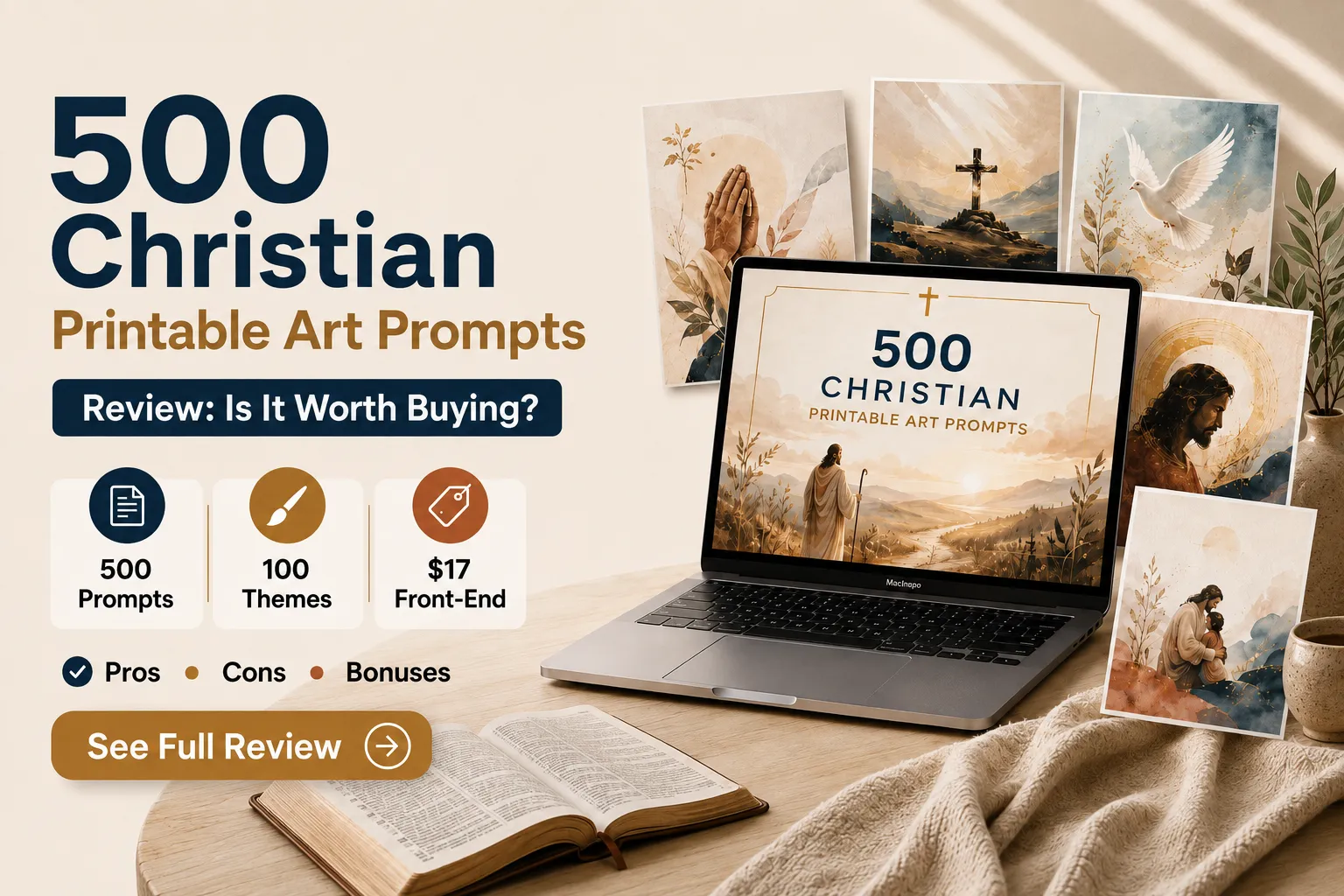
500 Christian Printable Art Prompts Review — In this detailed evaluation, we examine the product’s content, practical applications, pricing, upgrade path, strengths, limitations, and commercial potential for creators interested in Christian printables, digital wall art, journals, Scripture resources, and faith-inspired products.
Get 500 Christian Printable Art Prompts Through Our Affiliate Link
500 Christian Printable Art Prompts Review – Introduction
Creating a successful collection of Christian printable artwork requires much more than entering a few religious keywords into an AI image generator. Creators must identify meaningful themes, imagine appropriate scenes, define a consistent visual direction, write detailed prompts, evaluate generated images, correct visual problems, format finished files, prepare mockups, and package everything into products that appeal to a specific audience.
The greatest difficulty is often not generating one attractive image. It is producing an entire collection in which every image appears to belong to the same family.
A peaceful image of Jesus comforting a grieving person may look appropriate by itself, but it will not create a cohesive collection when the next image uses a dramatically different color palette, rendering technique, composition, character style, or lighting direction. Buyers looking for gallery wall sets, nursery collections, Scripture card bundles, prayer-room artwork, and devotional resources generally expect visual continuity.
500 Christian Printable Art Prompts has been created to address that problem.
The front-end offer provides 500 ready-to-use Christian art prompts organized around 100 faith-based themes, with five prompts allocated to each theme. The sales page presents the prompts as having a consistent abstract figurative direction and positions them for use with AI image-generation tools. It also includes additional resources such as 500 Bible inspiration prompts and a printable planning bundle.
This structure gives buyers a practical starting point. Instead of opening an image generator with no defined idea, they can choose a theme, work through its five related prompts, compare the outputs, and develop a coordinated set.
That does not mean every result will be immediately ready to sell. AI-generated artwork still requires judgment, refinement, quality control, and correct licensing. Nevertheless, a structured prompt vault can significantly reduce the early-stage work involved in choosing subjects and writing visual instructions.
The offer is particularly relevant to:
- Christian printable creators
- Etsy-style digital product sellers
- Faith-based content publishers
- Church resource designers
- Journal and devotional creators
- Print-on-demand entrepreneurs
- AI-assisted artists
- Bloggers and affiliate marketers serving Christian audiences
The central question is whether this prompt collection offers enough useful structure to justify its price. We will answer that by examining exactly what appears to be included, how the workflow functions, where the product can save time, and what buyers must still do themselves.
500 Christian Printable Art Prompts Review – Overview
The JV dashboard supplied for this review lists the front-end product at $17 and shows a launch date of August 3, 2026, at 8:00 PM US Central Time.
Here is the essential product information:
| Product Detail | Information |
|---|---|
| Product Name | 500 Christian Printable Art Prompts |
| Product Type | Digital AI art prompt collection |
| Front-End Price | $17 according to the supplied JV dashboard |
| Core Prompt Quantity | 500 Christian printable art prompts |
| Theme Structure | 100 themes with five prompts per theme |
| Primary Visual Direction | Consistent abstract figurative style |
| Primary Purpose | Creating coordinated Christian printable artwork |
| Additional Core Bonuses | 500 Bible inspiration prompts and six printable journals/planners |
| Access | Digital delivery after purchase |
| Refund Period | Sales page advertises a 30-day money-back guarantee |
| Best For | Christian product creators, printable sellers, designers, and AI art users |
| Affiliate Link | https://nhanscope.com/vyoh |
The product is not an automatic business, finished online store, guaranteed income system, or substitute for design judgment. It is primarily a creative production resource.
Its value comes from helping buyers move faster from an initial idea to a structured group of related images.
The sales page describes the collection as containing:
- 500 ready-to-use prompts
- 100 faith-based themes
- Five prompts for every theme
- A coordinated visual direction
- One consistent abstract figurative style
- 500 Bible inspiration prompts
- A six-product self-care, mindset, and life-planning bundle containing 270 pages
It also presents the prompts as useful for creating Christian wall art, Bible verse prints, Scripture collections, gallery wall sets, nursery printables, prayer-room artwork, devotional packs, journals, and planners.
This breadth is important because a prompt does not have to produce only one type of commercial asset. A strong image can potentially be adapted into several formats, subject to the applicable license and the rules of the AI platform used to generate it.
For example, one coordinated five-image theme might be repurposed as:
- A five-piece printable wall art set
- A collection of Scripture cards
- Covers for a prayer journal
- Interior dividers for a devotional workbook
- Social media graphics
- Church presentation artwork
- Bible study handouts
- Faith-based greeting cards
- Digital scrapbook elements
- Nursery or classroom decorations
The ability to repurpose artwork can improve the productivity of each prompt, but buyers should verify the exact commercial-use terms before publishing or reselling anything. The front-end sales page does not clearly describe the core prompt license as PLR, while several separate upgrades in the JV dashboard are explicitly labeled PLR.
That distinction should not be ignored.
What Is 500 Christian Printable Art Prompts?
500 Christian Printable Art Prompts is a curated library of written instructions designed to help users generate Christian-themed images with compatible AI image tools.
A prompt typically communicates visual information such as:
- The main subject
- The action taking place
- The setting
- The emotional tone
- The composition
- The color atmosphere
- The lighting
- The artistic style
- The intended relationship between characters
- The overall spiritual message
A weak prompt might say:
Jesus comforting someone.
That idea is understandable, but it leaves most visual decisions undefined. The AI tool must guess the setting, pose, framing, clothing, mood, background, palette, perspective, lighting, and rendering style.
A more structured prompt would define the scene in enough detail to produce a deliberate visual result. It might establish a quiet interior, a weary person seated beside a window, a supportive posture, warm ambient light, muted colors, simplified facial details, symbolic background elements, and a consistent abstract figurative treatment.
The purpose of the product is to provide that creative direction in advance.
The collection is organized into 100 faith-based themes, with each theme containing five related prompts. The sales page displays theme examples connected to compassion, comfort, human connection, spiritual journeys, fellowship, community worship, sacred celebration, guidance, service, peace, mercy, and hope.
This organization is one of the product’s most useful characteristics.
Rather than receiving 500 unrelated ideas in a single document, buyers receive a theme-based system. That system makes it easier to build collections.
A seller could select one theme and generate five images intended to work together. The seller could then evaluate the results, regenerate weak images, apply a common color treatment, resize the finished files, and release the five images as a coordinated bundle.
The product therefore sits between a basic idea list and a finished design library.
It gives users more direction than a list of topics, but it does not complete the final product-development process for them.
Buyers will still need to handle:
- AI image generation
- Prompt adjustment
- Image selection
- Artifact correction
- Resolution enhancement
- Cropping
- File formatting
- Typography
- Scripture verification
- Product packaging
- Mockup creation
- Listing copy
- Keyword research
- Customer support
- Licensing compliance
For a serious seller, these remaining tasks are not disadvantages unique to this offer. They are normal components of turning generated artwork into a polished commercial product.
500 Christian Printable Art Prompts Review – Features and Benefits
1. Five Hundred Ready-to-Use Christian Art Prompts
The main feature is the collection of 500 written Christian art prompts.
The immediate benefit is reduced preparation time. Instead of beginning every creative session with research and prompt writing, users can start with a prepared concept and modify it according to their preferred platform, audience, or design style.
This is particularly valuable for people who understand the type of product they want to create but struggle to translate an idea into effective visual instructions.
A creator may know that a collection should communicate peace, compassion, family, prayer, or spiritual guidance. The challenge is turning that general concept into multiple concrete scenes.
A prompt vault bridges that gap.
It also gives users a repeatable process. They can generate an image, assess the result, change a few variables, and compare versions without rebuilding the entire concept from the beginning.
2. One Hundred Faith-Based Themes
A large prompt count can appear impressive while still being difficult to use. Organization determines whether the content becomes a productive resource or an overwhelming archive.
The product’s 100-theme structure helps solve that problem.
The sales materials show examples involving Jesus welcoming the weary, listening to the burdened, comforting the lonely, encouraging the discouraged, supporting caregivers, guiding difficult decisions, strengthening families, traveling with pilgrims, gathering communities, and participating in shared worship.
These themes provide emotional and practical variety.
They can support products created for:
- Encouragement
- Grief and comfort
- Family devotion
- Christian friendship
- Spiritual growth
- Children’s spaces
- Prayer rooms
- Church communities
- Caregiver support
- Bible study
- Seasonal gifts
- Personal reflection
A creator does not have to publish all 100 themes. The collection can instead function as an idea bank from which the most relevant topics are selected.
3. Five Coordinated Prompts Per Theme
The decision to include five prompts per theme is commercially useful.
Single designs can be sold individually, but coordinated sets often create stronger product opportunities. A five-image collection gives sellers enough variety to package a bundle without requiring an unmanageable amount of production work.
Five related images can be positioned as:
- A gallery wall set
- A devotional series
- A weekly Scripture reflection collection
- A prayer-card bundle
- A five-part lesson resource
- A seasonal mini collection
- A coordinated journal accessory kit
The seller can also divide the collection into smaller products. Two images might become a nursery pair, three might become a triptych-style display, and all five might form a premium bundle.
This improves catalog flexibility.
4. A Consistent Abstract Figurative Visual Direction
Consistency is one of the product’s main selling points.
The sales page states that the prompts are built around a unified abstract figurative style rather than a random mixture of artistic treatments.
That does not guarantee identical AI outputs. Different image models interpret prompts differently, and even the same model can produce substantial variation across generations.
However, repeated stylistic instructions can create a stronger foundation for continuity.
A cohesive style can help sellers develop:
- Recognizable collections
- More professional product thumbnails
- Better-looking bundles
- Consistent store branding
- Coordinated social media content
- Repeatable visual identities
Buyers should still expect to regenerate some images and perform manual post-processing. Consistency must be evaluated across character proportions, facial treatment, palette, contrast, lighting, framing, texture, and background complexity.
The prompt is the starting point, not the final quality-control system.
5. Prepared Scene Direction
Many beginner prompts fail because they describe only the subject and omit the scene.
A commercially useful prompt needs more than a noun. It benefits from context, emotion, visual relationships, environmental details, and composition.
The product is positioned as providing clear scene direction so that users do not have to invent each setting from scratch.
That can be valuable when working with sensitive or emotionally meaningful topics.
A prompt involving grief, comfort, reconciliation, elderly care, family support, or spiritual guidance must communicate the intended emotion without producing a scene that feels chaotic, impersonal, or inappropriate.
Prepared scene direction gives the user a stronger first draft.
6. Compatibility With AI Image Tools
The prompts are designed to be used with AI image-generation platforms.
Users should expect to adapt the wording based on the selected tool.
Some platforms respond well to natural sentences. Others perform better with concise descriptive phrases, explicit parameters, reference images, negative instructions, or style settings.
A prompt may therefore require adjustments involving:
- Aspect ratio
- Stylization strength
- Image dimensions
- Rendering quality
- Seed consistency
- Negative prompts
- Character references
- Color references
- Composition controls
- Text exclusion
- Background complexity
The prompt library reduces ideation work, but the user remains responsible for learning the controls of the chosen image-generation platform.
7. Five Hundred Bible Inspiration Prompts
The offer also includes 500 Bible prompts for inspiration.
The sales page describes these as resources for personal devotion, Bible journaling, group studies, family discussions, exploration of biblical themes, and faith-based gifts.
This bonus expands the offer beyond visual art generation.
The prompts could potentially help users plan:
- Guided journals
- Reflection worksheets
- Bible study pages
- Discussion cards
- Devotional content
- Scripture journaling resources
- Family conversation prompts
- Church small-group materials
However, users should independently verify Bible references, quotations, interpretations, and theological statements before publishing them. A prompt can inspire a topic, but it should not replace careful scriptural review.
8. Six Printable Journals and Planners
The sales page also advertises a self-care, mindset, and life-planning bundle containing six journals and planners with 270 designed pages. Areas mentioned include gratitude, mindfulness, emotional wellness, habits, daily planning, goal setting, and personal growth.
This is not the central reason to buy the product, but it adds practical value.
The pages may give buyers additional product ideas, layout inspiration, or assets for personal and commercial projects, depending on the included license.
As with the main prompts, the exact license should be read before publishing modified or unmodified versions.
9. Multiple Product Possibilities From One Image
The sales page emphasizes that the same creative direction can be adapted into several types of Christian digital products. It specifically mentions wall art, Bible verse prints, Scripture collections, gallery sets, nursery printables, prayer-room artwork, devotionals, journals, and planners.
This is one of the strongest commercial arguments for the product.
A generated image does not have to remain a standalone art print. It can become part of a broader product ecosystem.
For example, a peaceful illustration based on a theme of spiritual guidance might be used as:
- A printable wall art design
- The cover of a prayer journal
- A divider page in a devotional
- A background for a Scripture card
- A church bulletin illustration
- A social media encouragement post
- A digital planner cover
- A Bible study worksheet header
The original image should be prepared differently for each use. A wall art file may require large dimensions and multiple ratios, while a journal cover requires typography-safe space and a specific trim size.
The creative asset is reusable, but the finished products still need individual design work.
10. Reduced Blank-Page Friction
The product’s most immediate benefit is psychological as well as practical.
A blank creative workspace forces the user to make too many decisions at once:
- Which biblical theme should we choose?
- Who should appear in the image?
- What should be happening?
- Where should the scene take place?
- What emotion should it communicate?
- What style should we use?
- Which colors should dominate?
- How can we create related images?
A structured prompt removes many of those initial decisions.
The user can begin by selecting, generating, evaluating, and refining rather than researching and inventing everything from zero.
This does not eliminate creative work. It concentrates that work on improvement and product development.
How Does 500 Christian Printable Art Prompts Work?
The product can be incorporated into a practical seven-stage workflow.
Step 1: Choose a Theme With a Defined Buyer
Do not begin by generating random images from several unrelated sections.
Choose one theme and connect it to a specific customer.
For example:
- Comforting Christian artwork for someone experiencing grief
- Peaceful nursery prints for Christian parents
- Encouragement cards for caregivers
- Scripture-inspired art for prayer rooms
- Faith-based wall art for church offices
- Devotional graphics for women’s Bible study groups
A clear buyer makes later design decisions easier.
Step 2: Review All Five Prompts in the Theme
Read the entire mini collection before generating the first image.
Look for repeated visual elements, emotional direction, locations, colors, character relationships, and opportunities to create continuity.
Decide which details must remain stable across all five images.
These may include:
- Color palette
- Character appearance
- Clothing treatment
- Lighting direction
- Brush or texture style
- Background simplicity
- Framing distance
- Aspect ratio
Step 3: Adapt the Prompts to the Chosen AI Tool
Copy the first prompt into the selected image generator and add any platform-specific instructions.
Useful additions may include:
- “No lettering”
- “No watermark”
- “Centered composition”
- “Soft muted earth tones”
- “Portrait orientation”
- “Minimal background”
- “Consistent character design”
- “Printable wall art composition”
- “Space for optional typography”
Avoid asking the image model to render long Bible verses directly into the artwork. AI-generated text is often unreliable. It is generally better to generate the art without lettering and add verified text later in a design application.
Step 4: Generate Several Variations
Do not accept the first output simply because it looks attractive at thumbnail size.
Generate multiple versions and compare:
- Hands and fingers
- Facial structure
- Body proportions
- Clothing details
- Repeated objects
- Background distortions
- Perspective
- Lighting
- Emotional expression
- Consistency with the other images
Select the strongest candidate and keep notes about the settings that produced it.
Step 5: Build the Complete Five-Image Collection
Once the first image establishes the preferred style, generate the remaining prompts with the same visual controls.
The objective is not merely to create five good images. It is to create five images that look intentional when displayed together.
Place the images side by side and evaluate them as a set.
A collection may fail even when every image looks acceptable individually. One image may be too dark, another too detailed, and another too realistic.
Consistency often requires additional generations or post-processing.
Step 6: Prepare the Commercial Files
After selecting the final images, prepare them for the intended product.
For printable wall art, this may involve:
- Upscaling
- Noise reduction
- Color correction
- Cropping
- Multiple aspect ratios
- High-resolution JPG files
- PDF instructions
- ZIP packaging
- Print guidance
For journals or devotional resources, the process may involve:
- Page layout
- Margins and bleed
- Typography
- Scripture verification
- Cover formatting
- Interior design
- PDF export
- Print testing
Step 7: Create the Listing and Launch
The final stage includes:
- Product naming
- Keyword selection
- Mockup creation
- Feature bullets
- Emotional positioning
- File descriptions
- Usage instructions
- License explanation
- Pricing
- Promotional graphics
The prompts accelerate the artwork stage, but the quality of the final offer depends heavily on these commercial details.
Start Creating With 500 Christian Printable Art Prompts
500 Christian Printable Art Prompts Review – My Experience Using It
For accuracy, this review is based on the public sales materials, the supplied JV dashboard, and a detailed evaluation of the advertised workflow. We have not independently inspected every file inside the paid member area, so we will not claim to have verified all 500 prompts line by line.
What we can evaluate confidently is the structure of the offer and how that structure would function in a realistic production process.
The Theme-Based Format Is More Useful Than a Random Prompt Dump
The strongest aspect is the decision to divide the library into groups of five.
A list of 500 disconnected prompts can produce 500 disconnected images. That may help with brainstorming, but it does not naturally support professional collections.
The five-prompt theme format creates a clear production unit.
A buyer can complete one theme, package one product, and then move to the next. This makes the library less overwhelming and supports a catalog-building workflow.
It also helps with scheduling.
A seller could aim to complete:
- One theme per week
- Two themes per month
- One mini collection every three days
- One seasonal catalog built from selected themes
The user does not need to generate all 500 images immediately. The sales page itself encourages buyers to begin with one theme and turn its five connected pieces into an initial collection.
The Product Solves Ideation Better Than Execution
The collection appears strongest at the idea and prompt-writing stage.
It helps answer:
- What should we create?
- What scenes could represent the theme?
- How can five images relate to one another?
- What visual mood should we pursue?
It does not completely answer:
- Which image model should we use?
- Which settings produce the best result?
- How do we repair artifacts?
- Which file sizes should we provide?
- What is the exact commercial license?
- Where should we sell the products?
- How should we price them?
- How do we write listings?
- How do we generate traffic?
That distinction is important.
A buyer expecting a complete done-for-you printable business may be disappointed. A buyer seeking a large, organized creative resource may find the product appropriately focused.
The Unified Style Can Save Considerable Trial and Error
One of the most time-consuming parts of AI art production is attempting to recreate a visual identity across several images.
By maintaining similar style language throughout the prompts, the collection may reduce some of that experimentation.
Nevertheless, consistent wording alone cannot guarantee consistent output.
For the best results, users may need to maintain:
- The same AI model
- Similar generation settings
- Consistent aspect ratios
- Repeated palette instructions
- Fixed character references
- Similar image seeds where supported
- Uniform post-processing
The prompts create the framework. The user must enforce continuity during production.
The Niche Is Specific Enough to Support Targeted Products
The Christian printable niche is broad, but the themes shown on the sales page are emotionally specific.
Themes involving grief, encouragement, friendship, elderly care, family, caregiving, community, pilgrimage, worship, hope, service, and reconciliation can be positioned around distinct customer needs.
Specific emotional positioning generally produces clearer product concepts than generic “Christian wall art.”
For example:
- “Christian wall art for grieving families” is more specific than “religious art.”
- “Faith-based encouragement cards for caregivers” is more specific than “Bible printables.”
- “Peaceful Christian nursery gallery set” is more specific than “Jesus artwork.”
The prompt themes can therefore support focused collections rather than broad, undifferentiated catalogs.
Quality Control Remains Essential
Christian artwork often carries strong emotional and spiritual significance. Errors that might appear merely awkward in decorative art can feel inappropriate in faith-based products.
Every generated image should be reviewed carefully for:
- Distorted anatomy
- Unintended symbols
- Inaccurate text
- Inconsistent character details
- Inappropriate expressions
- Cultural stereotypes
- Visual elements that conflict with the intended message
- Theological claims added in accompanying copy
- Unverified Scripture quotations
The artwork should also be tested at the actual print size. A design that looks clear on a screen may show artifacts, noise, or softness when printed.
Our Overall Experience-Based Assessment
From a workflow perspective, 500 Christian Printable Art Prompts appears most useful as a structured production accelerator.
It is not valuable merely because it contains a large number of prompts. Its practical value comes from the organization of those prompts into related groups.
At the listed front-end price of $17, buyers do not need to use all 500 prompts to recover creative value. Completing a few polished collections may justify the purchase for an active creator.
The product becomes less valuable when purchased without an implementation plan. A large prompt library can easily remain unused.
The best approach is to select one marketable theme, finish the five corresponding images, package a real product, and publish it before moving to the next theme.
500 Christian Printable Art Prompts Review – OTO Details
The supplied JV dashboard lists five products in the funnel ecosystem.
The screenshot is a product list rather than a visible funnel map, so the exact one-click upsell sequence should be confirmed during checkout. Based on the order shown, the products and listed prices are:
| Funnel Product | Listed Price | Our Evaluation |
|---|---|---|
| 500 Christian Printable Art Prompts | $17 | Core front-end prompt vault |
| 1,500 Christian Bible Verse Art Prompts (PLR) | $37 | Expanded Bible verse prompt collection with PLR labeling |
| 1,500 Christian Printable Art Prompts (PLR) | $27 | Larger general Christian printable prompt library with PLR labeling |
| 1,500 Christian Triptych Printable Art Prompts (PLR) | $37 | Prompts designed around three-panel art concepts |
| 500 Christian Triptych Printable Art Prompts + 3-Panel Split Tool | $27 | Triptych prompt collection plus a splitting utility |
Purchasing every product at the prices displayed would cost $145 before any tax or checkout variation.
The four additional products total $128 beyond the $17 front end.
Front End: 500 Christian Printable Art Prompts – $17
This is the product reviewed in this article.
It offers the lowest-cost entry into the funnel and appears sufficient for buyers who primarily need an organized Christian art prompt library.
We recommend beginning with the front end unless a buyer already knows that a larger library, PLR rights, or triptych production is essential.
Companion Product: 1,500 Christian Bible Verse Art Prompts (PLR) – $37
This product appears designed for creators who want a larger quantity of Bible verse-centered ideas.
The PLR label is potentially significant, but buyers should read the license carefully. PLR terms vary. Some licenses allow editing and resale of the written content, while others impose restrictions on unchanged distribution, marketplace use, attribution, or transfer of rights.
Do not assume that “PLR” permits every possible use.
This upgrade may suit:
- Scripture card creators
- Bible journaling publishers
- Devotional designers
- Christian social media agencies
- Faith-based content sellers
Companion Product: 1,500 Christian Printable Art Prompts (PLR) – $27
This appears to be a broader expansion of the front-end concept.
It may be worthwhile for high-volume creators who need more categories and intend to build a large catalog.
For beginners, more prompts do not automatically produce better results. A smaller collection that is actively implemented is more valuable than a larger library that is never opened.
Companion Product: 1,500 Christian Triptych Printable Art Prompts (PLR) – $37
Triptych art divides one visual concept across three panels or coordinates three related pieces.
This format can be attractive for wall décor because it creates a larger visual presentation and can be sold as a premium set.
However, triptych production requires careful alignment, cropping, spacing, and print preparation. The upgrade is most relevant to sellers specifically targeting multi-panel wall art.
Companion Product: 500 Christian Triptych Printable Art Prompts and 3-Panel Split Tool – $27
This product combines prompt content with a three-panel splitting tool.
The tool may reduce manual preparation for creators who regularly convert wide artwork into separate printable panels.
Before purchasing, buyers should verify:
- Supported file formats
- Maximum image dimensions
- Output resolution
- Cropping controls
- Whether it adds margins or bleed
- Whether it works online or requires installation
- Device compatibility
- Commercial-use permissions
Which Upgrade Should Buyers Choose?
The front end should be enough for buyers who want to test the workflow.
The larger PLR collections may be appropriate for publishers who already have:
- A functioning digital product store
- A defined Christian audience
- An image-generation workflow
- Experience packaging printables
- A plan to publish consistently
The triptych offers are more specialized. They make sense when three-panel art is central to the buyer’s product strategy.
There is no need to purchase every upgrade simply because it appears after checkout. Each product should be evaluated according to a specific publishing plan.
Pros and Cons
Pros
Large core library: Five hundred prompts provide substantial creative variety.
Organized theme structure: One hundred themes with five prompts each make the content easier to implement.
Collection-focused approach: The product emphasizes related artwork rather than disconnected single images.
Specific Christian positioning: It is designed for a clearly defined faith-based niche.
Prepared scene direction: Users can spend less time developing visual concepts from scratch.
Multiple product applications: Generated images may support wall art, journals, cards, devotional resources, and other formats.
Affordable front-end price: The supplied JV dashboard lists access at $17.
Additional resources: The sales page includes 500 Bible inspiration prompts and a 270-page journal and planner bundle.
Suitable for beginners and experienced creators: Beginners receive direction, while experienced users can adapt the prompts into advanced workflows.
Digital access: The sales page states that the download becomes available after the order is completed.
Cons
The prompts do not create finished products automatically: Buyers must generate, refine, format, package, and market the artwork.
AI output will vary: Results depend on the chosen image model, settings, and user skill.
Commercial rights require clarification: The core front-end sales page does not clearly label the primary product as PLR.
Scripture and theological content must be checked: AI-assisted material should not be published without review.
Large libraries can cause overwhelm: Buyers need a focused implementation plan.
Additional costs may apply: Image-generation subscriptions, upscaling tools, design software, marketplace fees, and mockup resources may be required.
The refund wording contains an apparent inconsistency: Although the sales page advertises a 30-day guarantee, the guarantee paragraph refers to “1,500 Christian Triptych Printable Art Prompts (PLR)” rather than the 500-prompt front-end product. Buyers should confirm the applicable refund terms before ordering.
No income is guaranteed: The sales page explicitly states that business results vary and that future earnings or success cannot be guaranteed.
Who Should Use 500 Christian Printable Art Prompts?
Christian Printable Sellers
This is the most obvious audience.
Sellers creating digital wall art, Scripture cards, prayer journals, devotional pages, and church resources can use the prompts as a starting point for new collections.
Etsy-Style Marketplace Sellers
Marketplace sellers who regularly need new product ideas may benefit from the themed structure.
The product can help them create collections around specific occasions, emotions, rooms, audiences, and faith-based needs.
They will still need to comply with marketplace policies concerning AI-generated content, intellectual property, disclosure, and digital products.
Print-on-Demand Creators
Some generated images may be adapted to posters, canvases, notebooks, cards, and other products.
Print-on-demand users should check image resolution, supplier requirements, color profiles, and commercial rights before uploading files.
Christian Bloggers and Publishers
Bloggers can use original, properly licensed artwork to support:
- Devotional posts
- Prayer resources
- Bible study articles
- Email newsletters
- Social media content
- Lead magnets
- Membership resources
The prompts may also inspire written topics, provided all religious claims are reviewed carefully.
Churches and Ministry Teams
Church teams could use the collection for internal creative inspiration when preparing lesson materials, event graphics, worship slides, discussion resources, or encouragement cards.
Usage depends on the license, especially when materials are distributed publicly or sold.
Journal and Workbook Creators
The prompt collection can support covers, section dividers, decorative pages, Scripture reflection cards, and supplementary illustrations.
Users should design around the practical requirements of print margins, trim sizes, bleed, and typography.
Beginners Who Struggle With Prompt Writing
A beginner may not understand how to specify mood, composition, lighting, setting, and style.
Starting with prepared prompts can shorten that learning curve.
However, beginners should still learn why a prompt works. Blindly copying prompts without evaluating results will limit improvement.
Experienced AI Art Creators
Experienced creators may use the prompts as idea frameworks rather than final instructions.
They can modify:
- Artistic movements
- Color palettes
- character designs
- Environments
- camera angles
- rendering methods
- aspect ratios
- emotional intensity
This can turn one prompt library into a much larger body of original work.
Who Should Not Buy It?
The product may not be suitable for people who:
- Expect instant passive income
- Do not intend to use AI image tools
- Want completed, ready-to-list products
- Are unwilling to review generated images
- Need guaranteed visual consistency
- Require custom hand-drawn artwork
- Have no plan to package or market digital products
- Are uncomfortable working in a Christian creative niche
- Need confirmed PLR rights for the core front-end prompts without first reviewing the license
It may also be unnecessary for highly experienced prompt engineers who already maintain a large private library of tested Christian art prompts.
500 Christian Printable Art Prompts Review – Price and Evaluation
At the $17 front-end price shown in the supplied JV dashboard, the offer is positioned as a low-cost creative resource.
The price should be evaluated according to time saved rather than prompt quantity alone.
Suppose a creator normally spends 20 minutes researching, writing, and revising the initial prompt for each scene. Preparing five related prompts might take more than an hour before image generation begins.
A themed prompt collection can reduce that preparation.
Even when the buyer modifies every prompt, starting with a structured concept is faster than beginning with a blank document.
The offer is therefore most valuable when:
- The buyer actively creates Christian products.
- The prompts are used to complete real collections.
- Generated images are carefully reviewed.
- Products are packaged professionally.
- Licensing terms are followed.
- The buyer publishes consistently.
It is less valuable when purchased only because the number “500” sounds impressive.
Value of the Front End
At $17, the front end appears reasonably priced for:
- 500 core art prompts
- Theme-based organization
- 500 Bible inspiration prompts
- Six journals and planners
- 270 supplementary pages
- A structured Christian creative direction
The sales page also advertises a 30-day money-back guarantee, although the product-name inconsistency in the guarantee paragraph should be clarified.
Value of the Full Funnel
The complete listed product set costs $145.
That amount may still be reasonable for a commercial publisher who needs thousands of prompts, PLR options, and triptych tools.
For a beginner, the complete funnel may introduce too much content at once.
The better purchasing decision is to connect each upgrade to a planned product line.
Do not buy a triptych tool without intending to create triptych artwork. Do not buy a 1,500-prompt PLR library without understanding how the PLR rights will be used.
Our Rating
Based on the advertised structure, price, niche focus, and implementation potential:
| Evaluation Category | Rating |
|---|---|
| Prompt Quantity | 9/10 |
| Organization | 9/10 |
| Niche Relevance | 9/10 |
| Beginner Accessibility | 8/10 |
| Collection-Building Potential | 9/10 |
| License Clarity on Public Page | 6/10 |
| Done-for-You Completeness | 6/10 |
| Front-End Value at $17 | 9/10 |
| Overall Assessment | 8.4/10 |
This rating assumes that the delivered files match the sales description and that buyers receive usable prompts in an accessible format.
Get 500 Christian Printable Art Prompts for the Listed Front-End Price
Exclusive Bonus Package for Buyers Who Purchase Through Our Link
Buyers who purchase through https://nhanscope.com/vyoh can qualify for the following exclusive five-part bonus package.
The stated combined value is $345.
Bonus #1: The Christian Printable Profit Launch Blueprint
Stated value: $97 Format: Step-by-step guide and action plan
This blueprint provides a complete roadmap for transforming one five-image theme into a polished Christian printable collection.
It covers:
- Image generation
- Image comparison
- Final selection
- Formatting
- Packaging
- Pricing
- Listing preparation
- Product launch planning
This bonus addresses the most important gap between owning a prompt library and publishing a product.
Many buyers can generate attractive images but become stuck when they need to decide what to do next. The blueprint turns the creative process into a defined sequence.
Instead of moving randomly between image tools, design applications, mockup websites, and marketplaces, users receive a workflow designed to take one theme from concept to launch.
Bonus #2: 100 High-Converting Christian Printable Listing Templates
Stated value: $67 Format: Copy-and-paste template vault
This collection contains adaptable:
- Product titles
- Descriptions
- Benefit bullets
- Keyword phrases
- Calls to action
- Emotional positioning angles
The templates are designed for Christian wall art, Scripture cards, journals, devotionals, and printable bundles.
This bonus can reduce the time required to write product listings.
A visual product still needs persuasive copy. Buyers need to understand:
- What the product contains
- Who it is intended for
- How it can be used
- Which files are included
- What emotional or spiritual benefit it offers
- Why a collection is different from a generic printable
The templates give sellers a framework they can customize rather than forcing them to write every listing from a blank page.
Bonus #3: The Cohesive Collection Quality-Control Checklist
Stated value: $47 Format: Checklist and visual evaluation workbook
This bonus provides a structured system for evaluating:
- Composition
- Color harmony
- Character consistency
- Lighting
- Typography
- Image quality
- Collection continuity
It also includes a scoring sheet for reviewing designs before publication.
This is a highly relevant companion to the core offer because prompt consistency does not automatically guarantee output consistency.
Users need an objective way to compare five images and identify which one disrupts the collection.
A quality-control checklist can prevent sellers from publishing products with obvious visual conflicts, weak resolution, distorted details, or inconsistent design treatment.
Bonus #4: 50 Profitable Christian Product Bundle Blueprints
Stated value: $77 Format: Product-idea guide and bundle planner
This resource contains 50 bundle concepts combining Christian artwork with potential products such as:
- Scripture cards
- Prayer journals
- Devotional pages
- Nursery prints
- Seasonal collections
- Bible study resources
Each blueprint includes:
- A target buyer
- Suggested bundle contents
- A positioning angle
- A recommended price range
The benefit is increased product leverage.
Instead of selling one generated image as one low-priced printable, users can combine multiple assets into a more complete offer.
For example, five coordinated images might become a package containing wall art, matching prayer cards, a journal cover, and devotional pages.
This approach can create stronger perceived value and more differentiated listings.
Bonus #5: The 30-Day Christian Printable Catalog Challenge
Stated value: $57 Format: Daily action workbook and progress tracker
This challenge provides a 30-day implementation plan covering:
- Theme selection
- Artwork generation
- File preparation
- Mockup creation
- Listing writing
- Product publication
- Catalog development
The main purpose is to prevent procrastination.
A 500-prompt library can feel overwhelming when the user has no schedule. The challenge divides the work into manageable daily assignments.
Rather than attempting to complete dozens of collections at once, buyers can focus on one defined task per session.
Total Exclusive Bonus Value
| Exclusive Bonus | Stated Value |
|---|---|
| Christian Printable Profit Launch Blueprint | $97 |
| 100 Listing Templates | $67 |
| Collection Quality-Control Checklist | $47 |
| 50 Product Bundle Blueprints | $77 |
| 30-Day Catalog Challenge | $57 |
| Total Stated Value | $345 |
To qualify for this exclusive package, complete the purchase through the affiliate link below and retain the transaction receipt for verification.
Purchase 500 Christian Printable Art Prompts and Qualify for the Exclusive Bonuses
Frequently Asked Questions
Does 500 Christian Printable Art Prompts Generate the Images for Us?
No. It provides written prompts and supplementary resources.
The prompts must be entered into a compatible AI image-generation platform. Users are responsible for selecting tools, generating images, refining outputs, and preparing finished files.
Do We Need Design Experience?
Advanced design experience is not required to begin, but basic image-editing and layout skills will improve the finished products.
At minimum, users should learn how to:
- Crop images
- Resize files
- Check resolution
- Add text correctly
- Export JPG and PDF files
- Create product mockups
- Package digital downloads
Can the Artwork Be Sold?
That depends on two sets of rights:
- The license included with the purchased prompt product
- The commercial-use terms of the AI image-generation platform
The public front-end sales page does not clearly state that the core 500-prompt product includes PLR rights. Buyers should read the delivered license before selling, transferring, or redistributing any content.
Can We Resell the Prompts?
Do not assume so.
The front-end product name does not include “PLR,” while separate upgrades shown in the JV dashboard do. Verify the license before reselling, modifying for resale, or distributing the written prompts.
Are the Generated Images Guaranteed to Match?
No.
The consistent prompt direction can improve continuity, but AI output remains variable. Users may need repeated generations, reference images, fixed settings, and manual editing.
Can We Add Bible Verses to the Artwork?
Yes, provided the verse is verified and used in compliance with the applicable Bible translation’s copyright terms.
It is usually better to add text manually in a design program rather than asking an image generator to render a full verse.
Is This a Complete Christian Printable Business?
No.
It is a creative resource that can support a business. It does not replace store setup, product research, design work, licensing review, customer service, traffic generation, or marketing.
Is There a Refund Policy?
The sales page advertises a 30-day, 100% money-back guarantee, but its guarantee paragraph appears to reference a different product title. Buyers should confirm the terms shown at checkout and retain a copy of the applicable policy.
Do We Need to Buy Every Upgrade?
No.
The $17 front end appears capable of standing alone for buyers who only need the core 500-prompt collection.
Upgrades should be purchased only when they match a clear publishing plan.
Conclusion
500 Christian Printable Art Prompts offers a practical solution to one of the most persistent problems in AI-assisted product creation: turning broad ideas into coordinated visual collections.
Its strongest feature is not simply the number of prompts. The strongest feature is the structure.
Five prompts per theme give buyers a manageable unit from which they can create gallery sets, Scripture cards, journal elements, devotional resources, nursery collections, and other faith-based products.
The product appears particularly valuable for creators who:
- Already understand their target audience
- Want to publish Christian digital products
- Need more visual concepts
- Struggle with prompt writing
- Want to improve collection consistency
- Are prepared to edit and package their work
It is not a push-button income system.
Buyers must still generate images, inspect every detail, confirm Scripture, understand licensing, prepare files, create listings, and attract customers. The sales page also makes clear that earnings and business success are not guaranteed.
At the $17 price displayed in the supplied JV dashboard, the front-end offer represents strong potential value for active creators. A user does not need to implement all 500 prompts to benefit. Completing several professional, market-focused collections may be enough to justify the purchase.
The most effective strategy is straightforward:
Choose one theme. Generate its five images. Refine them until they look cohesive. Package them into a finished product. Publish that product. Then repeat the process.
That disciplined approach turns the prompt vault from a large collection of ideas into a practical catalog-building resource.
Get Instant Access to 500 Christian Printable Art Prompts and Claim the Exclusive Bonus Package
Final verdict: 500 Christian Printable Art Prompts Review